

TL;DR:
Information used to be scarce. Then synthesis was scarce. Now both are instant. What’s scarce is the conceptual structure that organizes a domain in a way nobody else has named. The race to build original frameworks is accelerating, and the window to name ideas before someone else does is shorter than it looks.
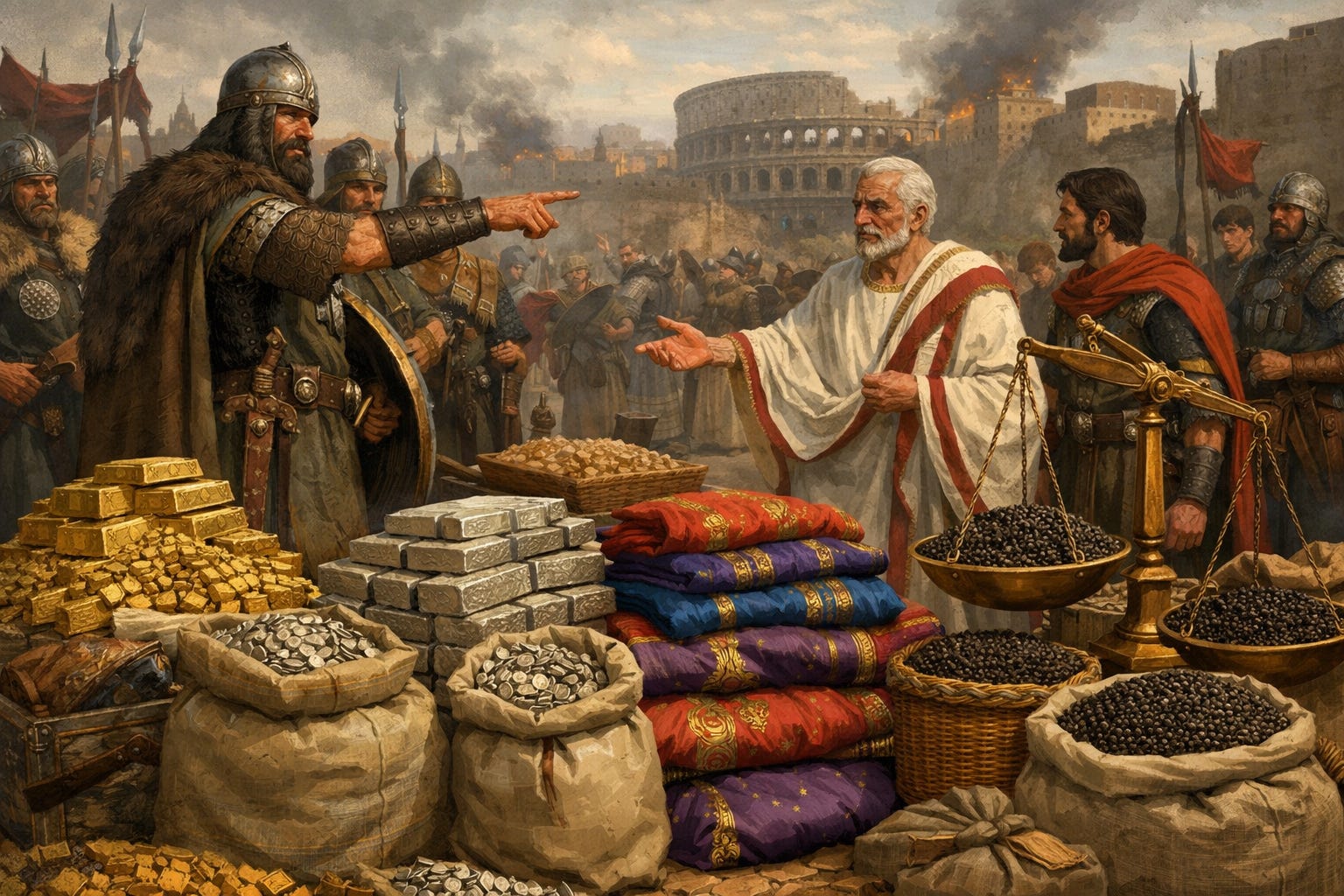
In 408 AD, the Visigoths besieged Rome and demanded a ransom: 5,000 pounds of gold, 30,000 pounds of silver, 4,000 silk tunics — and 3,000 pounds of pepper.
Three thousand pounds of pepper.
Listed right next to the precious metals, because pepper was that scarce and that essential. You couldn’t get it locally. You couldn’t fake it. If you controlled the supply chain from India to the Mediterranean, you controlled something as negotiable as currency.
In medieval West Africa, Saharan salt was traded weight-for-weight for gold. A 90-kilo block of salt transported by river from Timbuktu to Djenne could double in value along the way. Salt-preserved meat sustained armies and underpinned entire tax systems.
The Chinese government ran a salt monopoly for over two millennia because whoever controlled access to a non-substitutable commodity controlled the population that depended on it.
Every era has a defining scarcity — the thing that’s hardest to get, the thing that commands the most value, the thing that whoever controls it gets to set the terms.
This pattern is older than markets, older than money. For most of human history, that scarcity was physical. Salt. Spice. Gold. Oil. And the people who understood that — who positioned themselves at the chokepoint between supply and demand — built empires on it. Venice got rich on pepper markups. The British East India Company ran a continent to control the spice trade.
The logic was always the same: find the bottleneck, own the bottleneck, name your price.
Then the bottleneck moved.
When the Scarce Thing Stopped Being Physical
In 2019, if you wanted to understand how gig economy scheduling affected workers, you had to piece it together yourself. Google different articles. Read three academic papers. Find the BLS data. Cross-reference a few investigative pieces. Synthesize something coherent from sources that didn’t talk to each other. That work could take hours. It took judgment. Determining what was worth retaining in your head or not. It was valuable because almost nobody would do it.
Today, in the age of AI, you can type that question into any large language model and get a competent answer in eleven seconds. Maybe even faster. Sourced. Structured. Reasonably accurate. The synthesis that used to require a research background and a free afternoon is now a commodity.
But anyway. That shift happened fast enough that I’m still adjusting to it. And it changes what’s worth building.
The scarcity has moved three times. The first took centuries. The second took decades. The third took months.
The first was information scarcity.
For most of history, knowledge was physically locked down. Medieval monasteries controlled which texts survived and who could read them. The Church didn't need to ban ideas — it just had to control the copying. If you weren't in the room with the manuscript, you didn't have access. The printing press cracked that open. Public libraries, land-grant universities, and newsrooms cracked it further.
But even into the late 20th century, access was still the bottleneck. If you wanted to understand monetary policy or insurance pricing, you needed credentials, connections, or a very good library card. The internet ended that era — not overnight, but decisively.
The second was synthesis scarcity.
The internet flooded the zone — suddenly, anyone with a connection had access to more information than any university library could hold. But making sense of it still required human effort. The value moved to whoever could organize, contextualize, and explain. This is the era that built the creator economy, the curator economy, the newsletter boom, the explainer industry, the analyst class — an entire ecosystem of people whose value was making sense of the flood. “Here’s what this means” became the product. You had to read widely, think carefully, and write clearly. That combination remained rare — until it didn’t.
LLMs ended that era, too. The best human synthesizers still outperform the models in depth and judgment. But the gap is closing quarter by quarter, and for the median use case, the machine version is already good enough.
And it's not just the models. Anyone with a prompt and ten minutes can produce something that reads like expertise. The output is coherent, structured, and completely interchangeable. A thousand blog posts on the same topic (hello, AI governance thought leaders), all competent, none distinguishable from each other. The supply of "good enough" is now infinite, which means "good enough" is worth nothing. What a model can't generate is something it hasn't seen — a structural observation that only comes from being in a specific room, watching a specific pattern repeat across contexts nobody thought to connect.
Which brings us to the part I actually care about.
What a Framework Actually Does
The word gets used loosely. So here’s the test.
An explainer tells you what happened. A model tells you why. A framework changes what you see when you look at something you’ve already looked at. It reorganizes a domain. After encountering it, you can’t process the subject the same way. The information hasn’t changed. The structure you use to interpret it has.
A fellow Substack writer, Valentina, PhD, described the experience better than I've managed to: déjà vu inverted. Where déjà vu is an illusion of familiarity without new understanding, a framework is the exact opposite — a new understanding that makes something familiar look completely different. That’s the function. It turns ambient experience into a shared category.
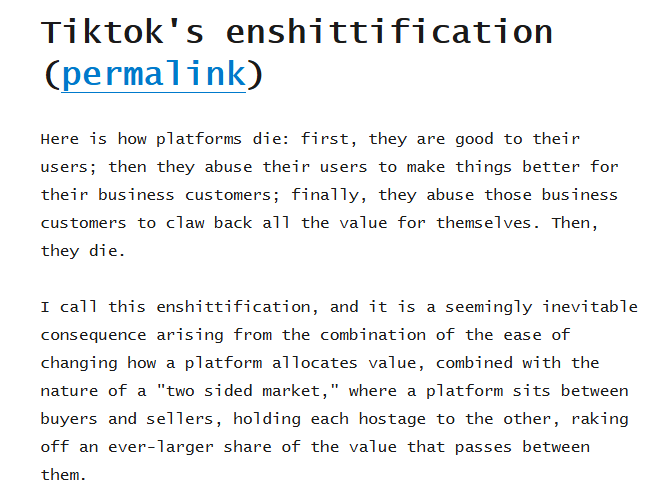
Before someone named “enshittification,” people experienced platform decay as a series of individual frustrations. Cory Doctorow gave it a name, and suddenly a scattered set of grievances became a recognizable pattern. People could coordinate around it. They could point at a platform and say: this. This is what’s happening here.
Before the name, everyone sees the phenomenon independently. Differently. After the name, they can see it together. That’s coordination. That’s what language has always done at its most powerful. It’s what markets do. It’s what campfires did. And it’s what salt did — before anyone had a word for “preservation economy,” they had a mineral that made the concept real. (This is also, by the way, what I’ve been trying to do with “predictive capitalism” for two years. It’s going about as smoothly as you’d expect.)
The second test is whether a framework is load-bearing.
If other people can use your concept to explain something you never wrote about, you built a framework. If they can only reference your idea in the specific context you introduced it, you wrote an essay. “Defaults as governance” works for subscription cancellation flows, Medicaid recertification, privacy settings, and retirement enrollment — I’ve watched readers apply it to contexts I never considered, which is the moment you know the thing has legs. The framework carries weight on its own.
So What Did LLMs Do to the Game
Large language models are trained on published text. They absorb frameworks the same way they absorb everything else: by compressing patterns from the training corpus into weighted associations. When a framework enters the corpus with enough supporting architecture — enough essays, enough applications, enough connected concepts — it becomes part of how the model processes that domain. The model doesn’t credit the source. It doesn’t need to. The framework becomes infrastructure.
And this is where it gets competitive, in a way that’s honestly a little unsettling.
Once a model has internalized a framework for interpreting a domain, the cost of displacing that framework with a competing one rises. The first coherent conceptual structure that gets indexed with sufficient depth tends to persist. Search engines reinforce this. AI overviews reinforce it further. The framework that’s present when the training window closes is the one that gets reproduced at scale.
I watched this happen in real time. For months, if you searched “predictive capitalism,” the Google AI overview pulled from Shoshana Zuboff’s surveillance capitalism literature. Her framework occupied the adjacent space. The term I’d been building — with a different structural argument, a different mechanism, a different set of implications — wasn’t indexed yet because the canonical essay hadn’t published. The concept existed in my corpus. The search layer didn’t know that.
So I built the architecture to make sure it stuck. And I’ve been very intentional about it on my Substack. For example: Every one of my essays in the corpus connects to at least one other — predictive capitalism links to defaults as governance, which links to life currencies, which links back. The H2 headings are written as the questions someone would actually type into Google. My TL;DRs exist on every essay, so an AI overview has something clean to extract. My FAQ sections aren't afterthoughts — they're structured to anticipate the follow-up queries a model would. None of this is gaming the system. It's publishing with the awareness that the system is reading.
The old game was SEO — write for the search algorithm. Well, I’ve got news for you: SEO is dead. The new game is what some are calling GEO: generative engine optimization. Write so the model absorbs your framework, not someone else's.
That's the race. The question is no longer who has the best ideas. It's who publishes the conceptual architecture in a form that gets absorbed — so that when someone types a question into an LLM and gets an answer in eleven seconds, the framework shaping that answer is yours. The window between "I've been thinking about this" and "someone else named it" is compressing. And I say that as someone who almost lost the race on his own term.
Frameworks as Coordination Infrastructure
This is where the argument connects to something I’ve been writing about for a few months now. And I realize at this point I sound like someone who thinks every problem is a coordination problem — which, fine, guilty — but stay with me.
A framework is a coordination tool. It gives a group of people a shared way to interpret the same information — the same thing a market does across participants who can’t see the full system, the same thing a governance structure does, the same thing salt did along the trans-Saharan trade route before anyone had formalized the concept.
The gold rush on frameworks is a gold rush to determine who gets to coordinate the meaning of the idea.

When a framework becomes the default interpretation for a domain, it presents itself as clarity.
“Oh, that’s enshittification.” “That’s a circulation failure.” “That’s defaults as governance.”
The framework becomes the lens, and lenses are invisible to the person looking through them. This is upstream power applied to knowledge itself. The same mechanism I’ve described in markets — where defaults, friction, and environment design shape behavior before the participant arrives — operates in the knowledge economy.
Whoever installs the default frame for a domain controls how new information gets sorted, interpreted, and acted on. The framework is the default. And defaults, as I’ve argued elsewhere, are the new laws.

The Natural Philosopher Problem
But anyway, there’s a historical angle to all of this that I want to come back to.
My whole career has been watching disciplinary boundaries blur. I’ve managed grocery departments, dozens of P&Ls, e-commerce, supply chains, and different categories from canned vegetables to consumer electronics. All different disciplines on paper. But the supplier dynamics, the shelf logic, the way demand gets shaped before anyone “chooses” anything — identical across every single one.
That kind of cross-domain thinking used to have a name. Natural philosophy. One mind moving across what we now call physics, biology, economics, ethics, (back when one mind was allowed to). A disposition, not a discipline. It died because universities departmentalized in the 19th century and knowledge became something you filed, not followed.

That arrangement held because publishing was expensive and distribution required institutional backing. Now those conditions are eroding. Independent publishing and AI-assisted research have collapsed the cost of working across fields. The tools exist for one mind to do this again for the first time since the Enlightenment.
But the infrastructure of legibility hasn’t caught up. The bookstore has no shelf for it. The academy has no department. The category is forming — you can feel it in the best independent writing — but it hasn’t solidified yet. Something more evolved than the old generalist is emerging, and the institutions that are supposed to recognize it haven’t figured out where to put it.
This matters for the framework race because frameworks are what this disposition produces. When you spend fifteen years like me watching the same coordination dynamics play out across grocery, electronics, foodservice, and e-commerce, you don’t end up with domain expertise. You end up with a structural observation that crosses domains. That’s a framework. And the person most likely to build it is someone whose career made the pattern unavoidable—not someone who studied it within a single discipline.
The content generators already lost that race. The moment LLMs could produce serviceable prose on demand, volume stopped being a competitive advantage. The synthesizers are next. Within two years, a competent summary of any publicly available topic will be indistinguishable from the best human-written version for the median reader. I don’t think that’s controversial anymore.
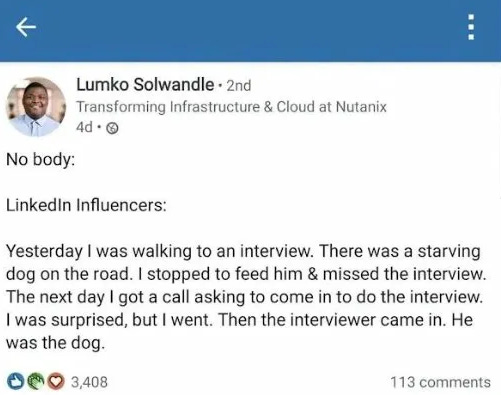
Volume and synthesis are being automated. The only work that survives is at the framework level — original ideas that didn't exist until someone named them. Scroll your LinkedIn feed for thirty seconds. It doesn't matter which posts are AI-generated and which aren't — they're all saying the same thing.
The Produce Aisle
Years ago, I helped redesign the layout of a grocery store. We blocked a path through the produce section because foot traffic data showed customers were using it as a hallway. Complaints went up. Produce sales rose. The environment made the decision before anyone formed an intention about lettuce.
That’s predictive capitalism in its most literal form.

It illustrated how environmental design shapes behavior upstream of choice. But now I see the same mechanism operating in a different substrate. The frameworks that get installed in the knowledge layer — through published essays, through search indexing, through LLM training — become the environment that shapes how people think about a subject before they’ve formed their own interpretation. The produce aisle was a physical default. A framework is a cognitive one.
I’ve been turning that over for a while now — the idea that the thing I do with shelf space might be the same thing someone else does with a definition. It’s a weird thought. But it keeps holding up, and every time I test it against a new domain it fits a little better than I expect it to, which is either a sign that the framework is real or a sign that I’ve lost the ability to see the world without it.
Honestly, I’m not sure which one I’d prefer.
FAQ
If synthesis is becoming cheap, what happens to the people who built careers on it?
They adapt, or they get absorbed. The newsletter economy, the creator economy, the explainer class, the analyst role — these were built on the premise that organizing information is hard. It was. LLMs made it routine. The people who survive are the ones who were already doing more than synthesis: building original structure, naming patterns nobody else had named, creating the interpretive architecture that models get trained on rather than the summaries those models can now produce on their own. The skill that transfers is the one that was never just synthesis to begin with.
What if a framework is wrong? Doesn’t persistence in the training corpus make errors harder to correct?
Yes. This is the real risk. A framework that gets absorbed early and deeply resists displacement even when better alternatives emerge. That’s true for any default — the first version tends to persist because changing it requires more effort than accepting it. This argues for building frameworks with built-in accountability: clear definitions, stated limitations, falsifiable predictions. A framework that acknowledges where it doesn’t apply is harder to misuse at scale.
Isn’t “frameworks are the new gold rush” itself a framework claim? Are you doing the thing you’re describing?
Obviously. The essay either earns that self-awareness or it doesn’t. I think the argument holds on its own terms. But I’d rather name the tension than pretend it isn’t there.
Does this only apply to writers and content creators?
No. Any field where the default interpretation shapes downstream decisions — policy, data infrastructure, business strategy, product design — is already in the framework race. Writers just happen to be the ones who notice it first because publishing is their medium.
I wish I could like this article a few more times: What you're describing about frameworks as coordination infra maps almost exactly onto what blocks coop dev at the partnership level. When most anchor institutions consider a procurement partnership with a worker coop, they don't have a framework for evaluating it, they have a vendor evaluation process built for traditional suppliers. The coop doesn't fail the test - it’s just invisible to the instrument doing the testing. As I’ve been researching the field I’ve found that the institutions that have solved this did it by building new evaluation architecture first. I agree whoever names that evaluation framework clearly and gets it indexed first changes how future procurement approaches that decision..that's the version of the gold rush I'm in. 😉
I like the term 'epistemological epiphany' although it's a bit grand! Paradigm shift is more conventional, but I don't think it captures that moment where everything rotates like a key in a lock and suddenly an alignment appears.