
Game Developers Figured Out Inflation. The Fed Never Had To.
What World of Warcraft, EVE Online, and a 1932 Austrian town can teach us about the monetary toolkit central banks never developed.

TL;DR
The Fed's entire inflation toolkit adjusts the price of credit system-wide — it has no mechanism for asking where money has stopped moving or who gets priced out.
The 2% inflation target isn't a law of physics. It's a policy choice invented in a 1989 New Zealand boardroom meeting that systematically benefits governments, corporations, and asset holders while workers holding cash accounts absorb the cost.
Game developers built better tools — targeted supply controls, wealth sinks, participation floors — because when their economies broke, players left and games died. Central banks face no equivalent pressure. In fact, the institutions that control monetary policy are structurally incentivized to keep inflation exactly where it is. The tools exist. The will to use them doesn't.
I’m a nerd. I’ve been playing World of Warcraft for almost twenty years.
WoW is many things — a fantasy world, a social network, a time sink of genuinely impressive proportions. I met my wife there — which is either a charming origin story or evidence that I spent too much time online. Probably both. But at its core it's also one of the most sophisticated economic simulations most people will ever interact with and never notice. One of my favorite things to do in the game isn't raiding or leveling. It's making gold on the Auction House.
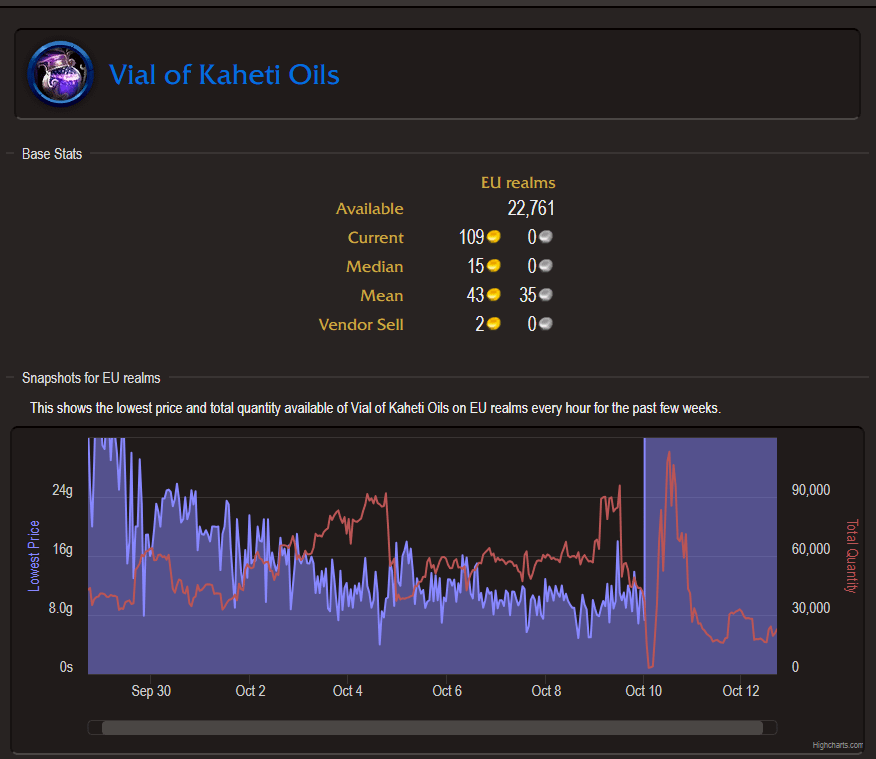
The Auction House is exactly what it sounds like: a player-driven marketplace where millions of players buy and sell everything from raw crafting materials to rare equipment, setting their own prices, competing for margins, and responding to supply and demand in real time. Back when I started, it was basic — just a list of items with prices. Now it looks like an investing app. Third-party tools like the Undermine Exchange pull real-time price graphs, moving averages, and volatility data on thousands of virtual commodities. It tracks buy walls and sell walls the same way a stock screener tracks resistance levels. And the patterns are identical to what you’d see in any real market: someone cornering the ore market before a patch drop to create artificial scarcity, then selling into the demand spike. Arbitrage windows opening and closing in minutes. Speculation, panic, manipulation.
Picture any market where buyers and sellers meet — stocks, crypto, groceries, housing, or yes, potions in a video game. The behavior is always the same. When sellers hold firm and refuse to drop their price below a certain point, you get a wall of supply sitting unsold — a sell wall. When buyers cluster at a price and won’t go higher, you get a wall of demand waiting — a buy wall. When something becomes scarce, prices spike. When someone floods the market with supply, prices collapse. Every market has these patterns because every market is just people with things to sell and people with money to spend, negotiating in real time. The product doesn’t change the mechanics. Gold coins in a video game. Tomatoes in a grocery chain. Mortgage-backed securities on Wall Street. Same graphs. Different labels.
It behaved like a market because it was one. When you bring together millions of people making real-time transactions on a shared platform tied to technology, you can study it like any other marketplace — and what you find looks less like a game and more like a mirror. Platforms like Amazon and eBay do the same thing on a larger scale, and nobody calls that a simulation. The only difference is what’s being listed.
And then, in the game, I watched what happened when the economy broke. Prices spiraled. New players couldn’t afford to participate. The economy didn’t collapse — it just got quieter, emptier, thinner. And the developers had to do something about it. Watching them reach for tools the Federal Reserve doesn’t have is what this essay is about.
Years later I’d spend fifteen years managing real retail economies — shelf placement, supplier negotiations, how products get priced and positioned, how money flows or stops flowing through a market system.
The mechanics were always the same. The toolkit never was.
This Is Happening Right Now in the US Economy
Earlier this week, the US Bureau of Labor Statistics reported that American consumer prices rose 3.8 percent annually in April — the highest since May 2023. For the first time in three years, real wages went negative. American paychecks grew 3.6 percent. Prices rose 3.8.
Since the pandemic began in early 2020, US prices are up roughly 25 percent overall — more than double the cumulative inflation seen in the five years before COVID. American rent alone is up 28.9 percent since February 2020. Gas. Groceries. Electricity. The stuff you can’t not buy.
Energy prices drove 40 percent of the monthly US gain — a direct consequence of the ongoing US-Israeli conflict with Iran disrupting global oil supply. Shelter costs jumped 0.6 percent. Tomato prices soared more than 15 percent for the second straight month. Fresh produce, transported by refrigerated diesel trucks, rose 2.3 percent — the highest monthly increase for that category since 2010.
These price increases are not landing evenly on American households. Energy and food take up a far larger share of spending among lower-income households than among upper-income households. A family spending 30 percent of its income on food and transportation feels 3.8 percent inflation like a gut punch. A household with significant investment assets watches its portfolio appreciate in nominal terms as prices rise — inflation partly cancels out the gains. For lower- and middle-income American households right now: debt delinquency rates are rising, real wages are negative, and the cost of the basic stuff — gas, groceries, rent — is climbing faster than paychecks.
The US response will be a debate about interest rates. It is always a debate about interest rates.
The Fed’s full toolkit — interest rates, bond purchases, reserve requirements, quantitative easing, macroprudential tools — all work through the same underlying mechanism: adjusting the price or availability of credit. They’re variations on one instrument. None of them asks where money has stopped moving. None of them protects people who are being priced out.
It’s a bit like the world’s most powerful central bank showing up to a precision problem with a trebuchet. Technically powerful. Impossible to aim.
The WoW economy emptied in exactly this pattern — money pooling, participation thinning, new players priced out — and Blizzard reached for tools the Fed doesn’t have. Which raises a question: how did we end up here, with one instrument and a 2% number that nobody voted on?

How We Got Here, and Who It Serves
The 2% inflation target feels like it was handed down from an economics textbook written before anyone alive today was born. It wasn’t. It was invented in 1989 by a freshly minted PhD economist at the Central Bank of New Zealand, essentially because someone in a meeting needed a number.
Arthur Grimes later described it: “We were saying, ‘OK, if we have independence, what should we target?’ And I just one day said, ‘Well, what are we trying to achieve?’” The number that came out of that conversation — not from research, not from a model, from a meeting — became the global standard. New Zealand adopted it officially in 1989. Canada followed in 1991. The UK in 1992. The European Central Bank in 1998. The US Federal Reserve made it formal in 2012. A number invented in a Wellington boardroom now governs the purchasing power of billions of people.
To understand why that number exists at all, you need to go back further.
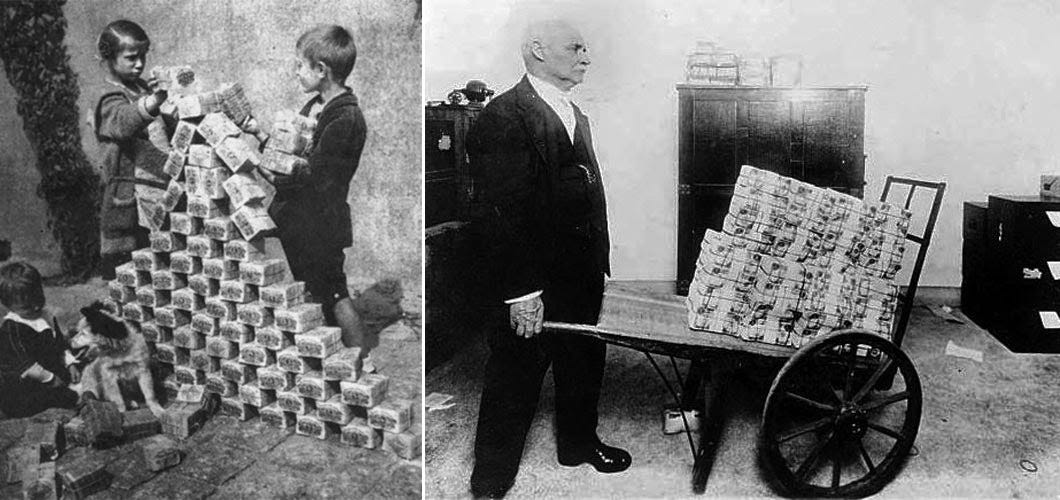
For most of economic history, inflation was considered purely bad. The psychological inflection point was Germany in the 1920s — not the comfortable consensus of modern central banking, but the chaos that preceded it. Hyperinflation was so severe that workers were paid twice daily because prices doubled between morning and afternoon. Wheelbarrows of cash to buy bread. That scar shaped monetary thinking for generations: inflation was the enemy.
Then John Maynard Keynes — the British economist whose ideas became the foundation of modern macroeconomic policy — changed the frame. Writing in the aftermath of the Great Depression, he argued that the problem wasn’t too much money in the system. It was money that had stopped moving. Demand had collapsed. People were hoarding. Prices were falling. And falling prices created a spiral: expecting things to be cheaper tomorrow, people delayed purchases today, which collapsed demand further, which drove prices lower, which caused more delays. The cure wasn’t austerity. It was stimulus — getting money circulating again, even at the cost of tolerating some inflation.
The post-war decades — roughly 1945 to 1970 — became what economists now call the Golden Age of Capitalism: low unemployment, modest inflation, rising wages, falling inequality. Governments ran deficits to fund growth. The theory was working.
Then the 1970s broke it. Two things happened almost simultaneously. First, in August 1971, President Nixon ended the convertibility of US dollars to gold — the arrangement that had anchored the dollar’s value since World War II. With the last link to gold severed, the world’s currencies, including the US dollar, were now completely unanchored. The Fed gained new freedom to expand the money supply. That freedom, used without the old constraints, contributed to rising inflation. Then the 1973 Arab oil embargo hit — oil prices quadrupled within months, gas stations ran dry, and consumer confidence collapsed. The result was stagflation: inflation and unemployment rising simultaneously, which Keynesian models said was impossible. The textbooks were wrong. The old consensus shattered.
Milton Friedman — the American economist who argued that controlling the money supply was the only real cure for inflation — and the monetarists stepped in: control the money supply, set an explicit inflation target, and stop letting governments spend their way out of problems.
Their ideas reshaped central banking through the 1980s. The question became: what number? Nobody had a rigorous answer. So someone in a meeting picked one. (The meeting was not recorded. No minutes were taken. The global standard for monetary policy was set the same way your office picks a lunch spot.)
New Zealand picked 2%. Everyone copied it. That’s the whole story.
What 2% Is For and Who It’s Actually For
The official argument for 2% is sound. Mild inflation keeps people spending rather than hoarding. For businesses and entrepreneurs, it provides a predictable environment: you can borrow to invest, price products with confidence, plan multi-year projects without fear of the floor dropping out.
It gives central banks room to cut rates during recessions without hitting zero. And it buffers against deflation — which, once it takes hold, is genuinely hard to escape.
That’s the case that makes it into speeches.
Here’s what doesn’t.
Governments carry enormous debt. The US currently carries more than $36 trillion. When inflation runs at 2% annually, the real burden of that debt erodes systematically — without anyone having to write a check or make a hard political decision. Corporations benefit differently: when prices rise 2% a year, an employer can freeze your paycheck and effectively give you a pay cut without the confrontation of actually doing it. Your check says $60,000. It buys what $58,800 bought last year. Nobody called it a cut. Nobody had that conversation. Not enough of a difference to protest over. Just enough to matter — which is exactly how a default works.
And then there are asset holders — people whose wealth sits in real estate, stocks, and business ownership rather than in a savings account. When inflation runs at 2%, those assets appreciate in nominal terms. Their net worth grows while yours shrinks, without either of you doing anything different. This is why financial advisors consistently warn against holding too much cash — money sitting in a checking account is the one asset guaranteed to lose ground every year under any positive inflation target.
It’s worth noting that inflation helps some working American households too — anyone with a fixed-rate mortgage benefits as inflation erodes the real value of that debt over time. But that benefit flows to homeowners. And American homeownership is getting harder to access, not easier. US home prices are up 60% since 2019. When the Fed raised rates from near zero to 5.25% between 2022 and 2023, the average 30-year mortgage rate went from 3% to over 7% — adding roughly $1,000 a month to the cost of buying a median-priced home. Meanwhile, 53% of American renters now spend more than 30% of their income on housing. Renters absorb the price increases with nothing appreciating on their side of the ledger.
Nobody voted on 2 percent. The Federal Open Market Committee adopted it, formalized it, and it has governed purchasing power for everyone ever since — through inertia, not consent.
One may ask: why not 0% inflation?
Here’s what 2% actually costs before answering that. If you hold $50,000 in a savings account earning little to no interest, you lose roughly $1,000 in purchasing power every year. At 3.8% — this week’s reported US rate — that same $50,000 loses nearly $1,900 in year one. Compound that across a decade: at 2%, $50,000 becomes worth about $41,000 in real terms. At a sustained 5%, it becomes $30,700. Not shocking in a single year. Compounded over a working life, it's the difference between building something and falling behind.
So why not just stop there — at zero?
The honest answer has two parts. First, the technical case against 0% is real: getting too close to zero leaves almost no room to cut rates in a recession without hitting the floor, and that constraint costs real economic damage in downturns. Japan’s lost decades — three decades of near-zero inflation, stagnant growth, and monetary policy with nowhere to go — are the standing evidence. Deflation, once it takes hold, is genuinely hard to escape.
But the second part is structural. A 0% world is harder on debtors — including governments carrying tens of trillions in nominal obligations (and boy, do we love debt). It forces honest conversations about nominal wages that corporations prefer to avoid. It removes the quiet annual transfer from cash holders to asset holders. Every institution with power over monetary policy benefits from mild inflation. None of them benefit from price stability.
And so 2% persists — not because 0% is impossible, but because it’s inconvenient for the people who set the target.
Inflation Is a Circulation Problem
Here’s what the Auction House in World of Warcraft actually taught me, years before I knew it was teaching me anything: inflation is a circulation problem before it’s a price problem.
If you visualize buying and selling across any market — stocks, crypto, American housing, or potions in WoW — you see the same behavior. Buy walls form when holders refuse to sell below a certain price. Sell walls collapse when supply floods in. Arbitrage windows open and close in minutes. The graph looks the same whether you’re watching crude oil futures or crafting materials before a content patch. Markets are markets. The currency is just the denominator.
And in WoW, I watched what happens when money stops moving.
Veteran players — people who’d been in the game for years, accumulating gold the way established wealth holders accumulate real estate and equities — had resources new players couldn’t touch. New players — the economic equivalent of someone entering the job market for the first time, trying to build a first stake with no inherited advantage — logged in and couldn’t afford basic gear, consumables, or the crafting materials to level their professions. Prices weren’t high because there was too much demand. They were high because gold had concentrated among long-tenured players and stopped circulating through the broader economy. The game was full of money. The money just wasn’t moving.
Replace “gold” with “capital.” Replace “veteran players” with “asset holders.” Replace “new players” with “entry-level workers trying to afford a first apartment or save a down payment.” The graph looks identical.
A collapse is visible. An emptying is not.
The standard inflation frame — too much money chasing too few goods — treats it as an aggregate problem requiring an aggregate solution. But that frame misses the mechanism. Money doesn’t disappear. It pools. It concentrates. And then it stops reaching the people at the bottom of the system.
The real economy works exactly the same way. The Fed’s tools — all of them — adjust the price or availability of credit across the entire system simultaneously. None of them ask where money has stopped circulating. None of them distinguish between the hedge fund rolling over leveraged debt and the household financing a used car. The targeting is by asset class, not by person. The family getting priced out of a mortgage this month is not a data point the Fed is optimizing for.
Game designers looked at this exact problem and built something different.
What Game Designers Built That Central Banks Didn’t
When the economy breaks in a game, players cancel subscriptions. When subscriptions cancel, the game dies. That survival pressure produces creativity that monetary policy has never needed to develop.
Here's what those digital economies actually built — and what it exposes about the toolkit monetary policy never had to.
Targeted supply reduction. When Blizzard let garrison missions in one of WoW's expansions — automated tasks characters could run while players slept — generate thousands of gold overnight per player, the money supply exploded across millions of accounts simultaneously. Blizzard’s short-term response was to raise the per-character gold cap from 1 million to 10 million. They didn’t solve the inflation. They raised the ceiling on it — the economic equivalent of a government raising the debt ceiling and calling it fiscal responsibility. Congress has done this eighteen times since 2001. Blizzard eventually fixed theirs.
Eventually they acted differently. In a later expansion, Blizzard cut specific gold rewards by roughly 80%. Quests paying 500 gold started paying 100. Not across the board. At the specific faucet generating excess supply. Surgically.
The US Federal Reserve cannot do this. An interest rate increase hits the person financing a used car the same as it hits a private equity firm rolling over leveraged debt. In theory, the real-world equivalent would look like the Fed being able to cool down lending in one specific sector — say, private equity — without touching borrowing costs for everyone else. That tool doesn't exist. Blizzard can patch a specific reward table. The Fed adjusts one number and watches it ripple everywhere at once.
Progressive wealth sinks. EVE Online is a space-based multiplayer game known for having one of the most sophisticated player-driven economies in gaming — real economists study it. CCP Games hired a PhD economist in 2007 to oversee the game’s economy full-time, the first virtual world economist in history. In 2025, they hired a former Central Bank of Iceland economist to run the economy of their next game. A game company hired a central banker. Because the problems are that structurally real. (The central banker presumably got health insurance. The EVE players got a quarterly economic report. Both seemed to find this arrangement reasonable.)
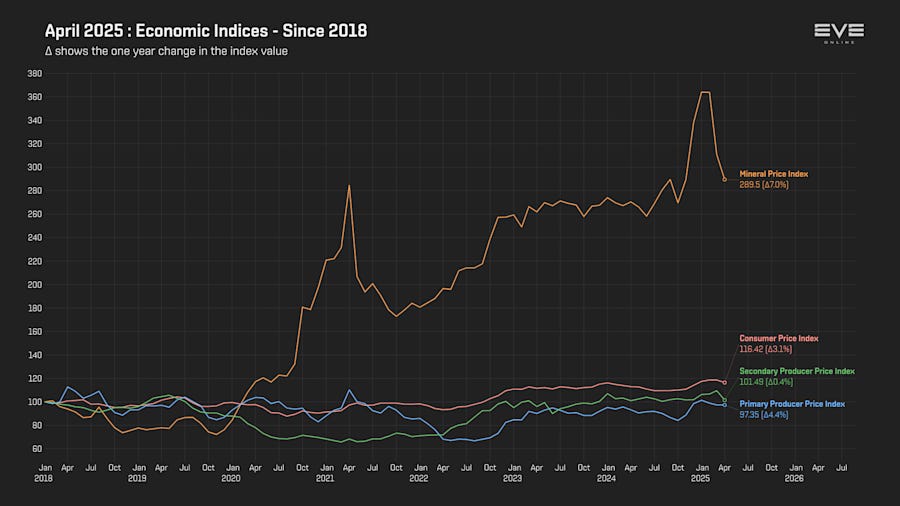
When EVE faced runaway accumulation of ISK — the game’s currency — among wealthy players, CCP engineered the Age of Scarcity. Resources grew harder to extract. Ship construction costs rose. Wealthy players flew expensive ships. Expensive ships get destroyed in combat. Wealth exited the system through participation — not through a flat tax everyone pays equally, but through a mechanism that extracted proportionally more from those with more to lose.
No real-world monetary policy equivalent exists. The closest analogy would be a wealth tax designed to function through behavior rather than levied directly. We’ve never built one.
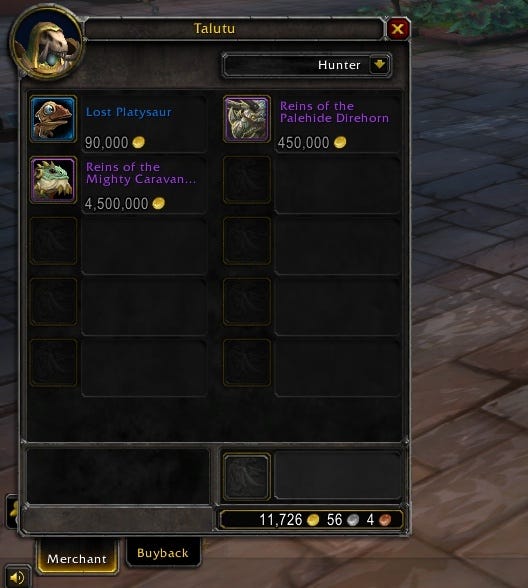
Prestige consumption sinks. RuneScape — a browser-based online game that's been running since 2001 and one of the longest-lived in history — charges players up to 100 million in-game gold for purely cosmetic items: a pet, a title, a visual effect that signals status and changes nothing else. WoW operates a similar system with rare items obtainable only by outspending other players at a special auction. Nobody is required to participate. They’re voluntary wealth absorption mechanisms that function because players with accumulated gold will spend it on status. The working-class player is unaffected. The player with hoarded wealth drains the pool chasing prestige. The gold leaves circulation at the top and stops pressing on prices at the bottom.
I’m not sure what the real-world equivalent looks like. (The closest thing might be a $450,000 Hermès Birkin bag — but that’s not exactly a monetary policy instrument. Or maybe it is and we just haven’t framed it correctly.) The tool exists in digital economies because designers had to invent it. It doesn’t exist in monetary policy because nobody’s job depended on inventing it.
Participation-protecting distribution. Second Life — a virtual world where players build, trade, and run actual businesses — ran a universal basic income. Small weekly currency stipends calibrated to keep new and low-wealth participants active in the economy. Not enough to cause inflation. Enough to keep people in the market. The goal wasn’t equality — it was keeping participation broad enough that the market stayed alive. Second Life traded $10 billion in virtual goods over 20 years. During 2020, while real-world economies contracted, Second Life’s GDP grew 30 to 40 percent. The participation floor held because the designers built one. The US Federal Reserve has no participation floor. When rates rise, the people priced out of housing, credit, and investment first are the ones who could least afford the exclusion.
What happens when none of these tools exist. Axie Infinity was a mobile game built on blockchain technology — think Pokémon, but the creatures were NFTs and the in-game currency was a real crypto token you could cash out for actual money. Scholarship programs emerged in the Philippines: players who couldn’t afford the startup cost borrowed accounts from wealthier owners and split the earnings. At its peak, some scholarship players were earning multiples of the local minimum wage playing a game. I was in it briefly. The mechanics made psychological sense even when the math didn’t.
The economists who looked at the token structure said from day one the math didn’t add up. Four times more tokens were being minted daily than burned. The money supply was expanding against nothing. At its peak, Axie had 2.7 million daily active players. Then the token crashed 99 percent. The scholarships dried up. Players who had built real livelihoods on Axie earnings had no recourse. No deposit insurance. No central bank backstop. No circuit breaker. The economy emptied in months, and the people it emptied on first were the ones with the least margin for it.
The people who understood game economy design saw it coming. The people in the Philippines didn’t have the luxury of being early exits.
The Tools We Already Know Exist
Here’s the uncomfortable part: we’re not short on ideas. We’re short on will.
But these aren’t just game mechanics. The same principles — making hoarding costly, keeping circulation broad, protecting participation at the entry point — have been attempted in the real world. Some worked. Most were stopped before they could scale.
The Wörgl Experiment
In 1932, a small Austrian town of around 4,000 people tried something no central bank would sanction. Wörgl had roughly 1,500 people out of work. The town was going bankrupt. Infrastructure was crumbling. Many unemployed had been out of work so long they no longer qualified for benefits.
The mayor, Michael Unterguggenberger, was a railway worker turned local politician — not an economist. He’d read an obscure German merchant named Silvio Gesell who had developed a theory watching Argentina’s currency crisis in the 1890s. Gesell’s insight: money is different from every other good in the economy because it doesn’t decay. A farmer’s wheat rots. A worker’s labor expires. But money can sit in a vault indefinitely, giving whoever holds it an asymmetric advantage over everyone who has to sell something perishable. That hoarding premium, Gesell argued, was the actual disease — not money supply.
Unterguggenberger went door to door explaining the concept to his neighbors before launching anything. Then he printed his own currency.
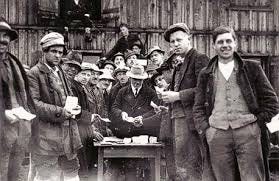
32,000 labor certificates, accepted for local taxes, rent, and goods. The catch: they depreciated 1% per month. Hold them and they lose value. Spend them and they don’t.
The certificates circulated 13 times faster than the national schilling. Thirteen times. Unemployment in Wörgl fell 16% while the rest of Austria’s rose 19%. Roads were repaired. Streets were asphalted. A ski jump was built. A bridge. Tax revenue went from 2,400 schillings in 1931 to 20,400 in 1932. A ninefold increase in twelve months — as people used the certificates to clear tax debts that had been frozen for years.
Irving Fisher — one of the most prominent American economists of the century — studied the results and lobbied Congress to copy the model. John Maynard Keynes later called Gesell a “strange, unduly neglected prophet” with “flashes of deep insight.” Édouard Daladier, the former Prime Minister of France, visited Wörgl personally. In June 1933, Unterguggenberger briefed 170 Austrian mayors in Vienna. Two hundred cities were preparing to launch their own versions.
Austria’s central bank shut it down in November 1933. The objection wasn’t economic. It was jurisdictional — printing currency was a bank’s job, not a mayor’s. The Higher Administrative Court agreed. The certificates stopped. The unemployment returned.
Nobody in the court filings argued the economy of Wörgl was doing worse.
Targeted monetary transfers. Ben Bernanke did not go door to door. But the idea was similar. The “helicopter money” concept — newly created money going directly to households — has been proposed by economists including Bernanke. US COVID stimulus checks were a crude version of this, and yes, they contributed to the post-pandemic American inflation surge. PPP loans were plagued by fraud and misallocation. The point isn’t that crude implementation worked — it didn’t, fully. It’s that the precision version, calibrated to keep circulation broad rather than flood the aggregate system, is a fundamentally different tool than what was actually deployed.
Wealth circulation mechanisms. Progressive transaction costs, tiered asset holding taxes, mechanisms that make hoarding progressively more expensive while leaving ordinary spending untouched — these exist as proposals across the ideological spectrum, from Gesell's free money theories to proposals across the modern left and right. They've never been implemented at scale in a major economy.
Lowering the friction cost of participation. In 2007, a Kenyan mobile phone company launched M-Pesa — a system that let people send, receive, and store money via basic SMS, no bank account required. It didn’t touch interest rates. It didn’t adjust money supply. It simply made it cheaper and easier for people who had been priced out of the formal economy to circulate money. Within a decade, M-Pesa had brought formal financial services to 83 percent of Kenya’s population. By 2025 it had over 60 million active users processing billions of transactions annually. The economy didn’t need a new lever. It needed lower friction at the entry point. That’s a circulation tool. The US Federal Reserve doesn’t have one.
What all four have in common: they target the circulation problem rather than the aggregate price level. They ask where money is pooling and who gets priced out, instead of adjusting one number and watching it ripple everywhere at once.
They also share something else. Every time one has gotten close to implementation, the institutions with the most to lose — governments protecting debt dynamics, banks protecting lending margins, asset holders protecting appreciation — have found ways to stop it.
The Wörgl currency was working. The central bank shut it down anyway. Not because the economy was doing worse. Because it was working without them.
The Reason the Gap Exists
Game designers solved inflation because they had to. The feedback loop was fast and existential. Economy breaks — players leave — studio loses revenue — game dies. Measurable in a quarterly earnings report.
Real economies don’t have that feedback loop (thankfully — though history suggests that when the lag gets long enough and the hollowing-out deep enough, the feedback arrives in messier forms: political upheaval, social discontent, the occasional revolution).
An economy can narrow for decades while technically functioning. GDP grows. Asset prices hold. Employment numbers stay in a range that reads as acceptable. The interior hollows out and the dashboard never registers it as a crisis.
The 2% target was set by institutions with specific structural interests in mild positive inflation: governments eroding nominal debt, corporations adjusting real wages without confrontation, asset holders watching portfolios appreciate while savings accounts lose ground year after year. It takes effect through inertia. If you do nothing — if you simply hold dollars, as working-class American households without investment accounts disproportionately do — the target governs your purchasing power. Every year. Without your consent and without your input.
Game designers didn’t figure out better tools because they’re smarter than central bankers. They figured them out because their players could cancel subscriptions. The feedback loop was immediate and the stakes were clear.
The people most affected by how the 2% target functions — the ones holding cash instead of assets, the ones borrowing to participate instead of lending to profit, the ones whose wages don’t keep pace with the inflation the target is designed to sustain — don’t have a cancel button.
They just absorb it and call it the economy.
What would monetary policy look like if the people designing it had to live inside the economy they designed — and the economy ran quarterly reports on who it was actually serving?
FAQ
Isn’t deflation worse than mild inflation?
Yes — and that’s a real argument. Falling prices cause consumers to delay purchases, demand collapses, unemployment rises. Japan’s lost decades are the standing example. But 0% inflation is price stability, not deflation. The Fed conflates the two because the alternative sounds catastrophic enough that nobody seriously proposes it. The question isn’t whether deflation is bad. It’s whether 2% is the only alternative to it — or whether that framing exists because 2% serves specific institutional interests.
Are digital economies really comparable to real ones?
At this point the question almost answers itself. E-commerce — Amazon, eBay, Shopify, every marketplace where prices update in real time, supply signals move in milliseconds, and algorithms set floors and ceilings before a human sees the listing — is a digital economy. It processed over $6 trillion in global sales in 2024. Nobody asks whether that’s a “real” economy.
The game economy comparison just takes it further. CCP Games hired a former Central Bank of Iceland economist to run EVE Online’s economy full-time. Indiana University researchers ran a 575,000-participant experiment confirming that virtual monetary policy produces identical behavioral responses to real-world policy — inflation, demand shifts, hoarding — just faster and with full data visibility. Second Life players cashed out $73 million in real USD in 2020 alone. The line between virtual and real economies isn’t a line anymore. It’s a spectrum, and we’re already well past the midpoint.

Is this an argument against the Federal Reserve?
It's an argument about toolkit design and institutional incentive. The Fed operates with the instruments it has. The question is why those instruments were never expanded — and whether that's a technical limitation or something more structural about whose interests the current toolkit serves.
Are you seriously suggesting we apply video game economies to real life and expect them to work?
That’s a reasonable objection. Game economies have controlled populations, clear rules, and developers who can patch problems overnight. Real economies have 8 billion people, competing governments, and centuries of entrenched institutional interests. Nobody is suggesting the Fed should hire a World of Warcraft guild leader and call it a day. But the Wörgl experiment wasn’t a video game — it was a real Austrian town in the real Great Depression, and a circulation-focused currency cut unemployment 16% while the rest of Austria’s rose 19%, before a central bank shut it down on jurisdictional grounds. The objection wasn’t that it wasn’t working. The objection was that a mayor had done it instead of a bank. Economists debate exactly how much of that result came from the demurrage feature versus the fiscal stimulus it enabled — but the result itself is documented. The tools aren’t fantasy. The question is whether the institutions that would have to implement them have any incentive to do so. So far, the answer has been no.
Great read. Really well articulated, and what an important (albeit for some readers perhaps slightly obscure) topic. I studied Economics in University, and wrestled with the same doubts about the system architecture around monetary policy and inflation as an assumed necessity above 0%. Your focus on the "one size doesn't fit all" policy failing is really insightful. I briefly studied alternative economics in one module, and the idea of "alternative currencies" is a really cool one - in that it provides a means of both adjusting for the failure on one system (e.g., state backed central bank system), and inherently creates competition between complementary systems for exchanging value, which creates the very "feedback loop" you mentioned that applies in video games. If people could choose between 2, 5, or 10 ways of exchanging value, the average person would ultimately start using the system that best maintained their purchasing power. The retreat from other systems might just give them the incentive to pivot from protecting wealth (hoarding) to rewarding the more median person in the economy.
So, one of the differences that comes to mind on toolkits is that we've historically relied on entrepreneurship and investment as the wealth sinks; games put a lot tighter constraints on those for the most part, the closest you get is mods.