
The Bread and the Algorithm
How the world’s most frictionless wealth transfer was built by accident


TL;DR
A baker in Uzbekistan pulls bread from a clay oven. A grandmother in India cooks for a hundred kids in her village and gives the food away. Their videos go viral. American ad dollars flow through a platform pipeline and land in economies where a few thousand dollars can reshape a family’s life. Nobody designed this outcome. Nobody governs it. The creator economy’s biggest promise was independence through content. The irony is that it delivers most powerfully for the people it was never built for, in places its architects never imagined, and only as long as those places remain poor enough for the math to work.
My partner, Tori, and I were on the couch the other night watching a YouTube video of an Indian grandmother cooking an enormous amount of food.
We didn’t know what we were watching at first, just that we couldn’t stop. She and her grandsons were adding obscene amounts of butter, oil, and seasonings into pots big enough to bathe in, working over giant woks with the kind of calm authority that only comes from doing something your entire life. Tori and I just kept looking at each other like, how much food is this? Who is all of this for? We didn’t find out until the end of the video. She was feeding about a hundred kids in her village. She gave it all away.
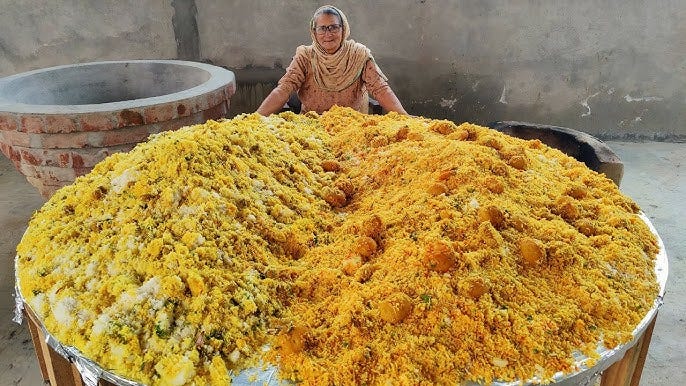
The channel was called Veg Village Food. I found out later that the grandmother's name is Amar Kaur, and she's in her mid-seventies. The particular video we watched had millions of views. There were dozens more like it on the channel.
We watched another one after that — a baker in Uzbekistan working in a small village with a clay oven. Between the cooking shots, the video cut to long, still shots of his surroundings. Nothing extravagant—dusty roads, low buildings, a quiet that felt like it belonged to the place and not to a production choice. That one had millions of views too.
And it wasn’t just food. We’d been down this rabbit hole before without realizing it was the same rabbit hole. Rural Chinese creators making handmade pottery from river clay. Guys in the woods building entire cabins with hand tools and no narration. All of them had the same quality — no production, no polish, just someone doing something with their hands in a place that looked nothing like the internet around it. All of them had millions of views.
And I kept noticing the view counts, which is when I started doing math in my head without meaning to (because I’m just weird like that). How much does YouTube actually pay a creator in a developing country? Where does that money come from? Where does it land? And what does it buy when it gets there?
That math led somewhere I genuinely didn’t expect.
How Much Does a Viral YouTube Video Actually Pay a Creator?
YouTube pays creators through its AdSense program, and the split is 55% to the creator, 45% to YouTube. The amount a creator earns per thousand views is called CPM, and it varies wildly depending on one variable above all others: where the viewers are, not where the creator is.
And the gaps are enormous. In 2026, the average CPM in the United States is roughly $33. In Australia, it’s over $36. In India? Under a dollar. Uzbekistan is lower still. So a viewer in Arkansas (hi) generates somewhere between 30 and 45 times as much ad revenue as a viewer in rural India watching the exact same video. The gap has actually widened over the past three years, which is the kind of trend that should make you stop and re-read the sentence.
This creates a strange arithmetic that I’ve been thinking about. Amar Kaur’s channel, Veg Village Food, has over 6.6 million subscribers and more than 2.2 billion total views. Her most popular video, a samosa recipe, has been watched 147 million times. Estimates put the channel’s earnings between $55,000 and $124,000 per month, potentially over $1 million a year. And she started the channel in 2014 from a village courtyard, cooking the same food she’d been cooking her whole life, giving it away to neighborhood kids.
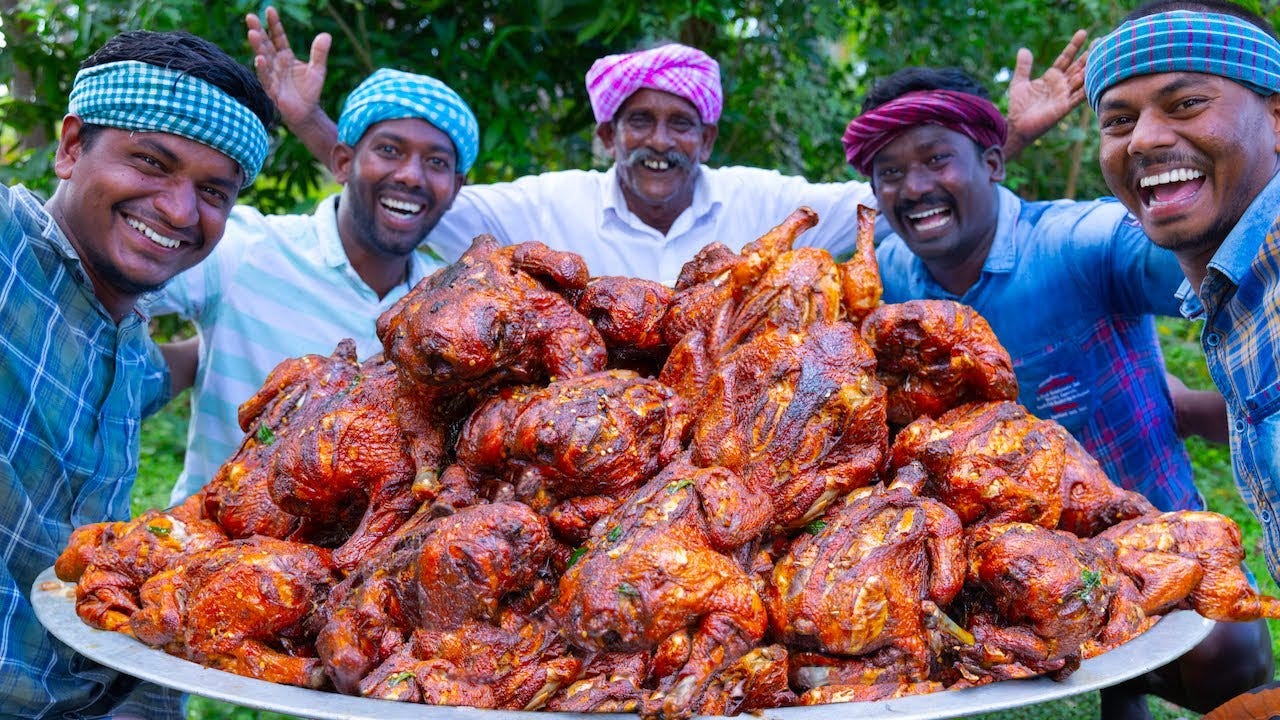
She’s not the only one. The Village Cooking Channel, run by a 75-year-old farmer named Periyathambi and his five grandchildren from Pudukkottai district in Tamil Nadu, has 30 million subscribers and videos that have each garnered over 100 million views. That channel’s estimated annual revenue is in the millions.
For context, and this is where it gets wild: the average monthly income for a rural Indian household is about $150, according to NABARD’s national survey. In Uzbekistan, the average monthly salary is around $450, with rural workers earning considerably less and the minimum wage sitting around $100 a month.
To make this more concrete: a thousand views from US audiences pays a YouTube creator roughly $4 to $12 after YouTube’s 45% cut. Doesn’t matter if the creator lives in Brooklyn or a village outside Bukhara. Same views, same payout. But that $10 buys the American creator a fast-food lunch (Taco Bell, anyone?). For the Uzbek creator, it’s three full restaurant meals with change left over, in a country where bread can cost as little as fifteen cents a loaf and a sit-down lunch runs under three dollars. Same platform, same algorithm deciding who gets seen, completely different lives on either side of the screen.
So… A single viral video earning what a mid-tier food blogger in Brooklyn would consider a decent week's income can represent months of income for a family in these economies. A channel with consistent traffic doesn’t just support a household. It becomes an economic anchor for an entire village, and I don’t mean that metaphorically.
And that’s before the infrastructure takes its cut from the creator.
A creator in the Global South can lose 15 to 20 percent of their earnings to platform fees, currency conversion, and payment processing before the money reaches an account they actually control. Stripe doesn’t operate as a payment receiver in most of South America, most of Africa, and large parts of Asia. PayPal restricts accounts in dozens of countries. The platforms that promise “the world is your market” work beautifully until the creator hits the cash-out screen and discovers their country isn’t on the list.
For creators in the Global North, that friction barely registers. For creators everywhere else, it’s an invisible tax on top of every other disadvantage.
Marcela Distefano documented this pipeline in detail in her recent essay on how global payment infrastructure marginalizes creators from the Global South — the friction is structural, not incidental.
In the village of Tulsi in Chhattisgarh, India, over a quarter of residents now earn income from YouTube. Many pull in over 30,000 rupees a month (roughly $330), which rivals urban salaries in India. Women who previously did unpaid household work are now out-earning their husbands through cooking tutorials and daily-life content. Two young men started the whole thing. Within months, they were teaching their neighbors how to do it too. The village’s economy didn’t gradually shift. It reorganized around a platform that nobody in the village had considered two years earlier.
I should be honest about scale here. Global foreign aid runs about $200 billion a year. Remittances to developing countries top $650 billion. YouTube’s total creator payouts globally are somewhere around $16 to $20 billion, and only a fraction of that reaches developing-country creators. Amar Kaur and the Village Cooking Channel are vivid examples, but they’re not typical. Most creators in India or Uzbekistan are earning from domestic audiences at sub-dollar CPMs, and the cross-border attention arbitrage I’m describing is a real pipeline but not the dominant one. What makes it worth examining isn’t its size. It’s that it runs with zero bureaucratic overhead, zero institutional design, and zero awareness from the people inside it. Per unit of friction, nothing else comes close.

And yet. There's a version of the creator economy story that the West has fully bought into, and honestly, I’ve told it to myself. It goes like this: build an audience, find your niche, monetize your passion, quit your job, live free. The platforms encourage it. The culture celebrates it. The economics almost never support it.
The numbers are rough. Only 12% of full-time creators make more than $50,000 a year. Nearly half make less than $1,000. The median Substack writer with paid subscribers earns about $4,000 annually. The top 10% capture 62% of all payments on the platform. On Substack, 52 newsletters clear $500,000 a year out of over 17,000 paid writers.
None of these figures come from Substack directly, so take them for what they are — but I've spent years in category management watching the Pareto principle play out across every category I've ever touched, from consumer electronics to grocery to foodservice. The top 20% of SKUs account for 80% of revenue almost every time. It's not true all the time, but it's close enough that you stop being surprised by it. The top handful of suppliers capture most of the margin. The shape of the distribution is always the same. And if we think of writers on Substack as suppliers of content, we shouldn't expect any different.
I just turned on paid settings recently on Substack, and I already know the math. Say you charge $7 a month. Substack takes 10%, Stripe takes another 3% plus thirty cents per transaction. You're left with about $6 per subscriber per month. To hit $60,000 a year, that's $5,000 a month, which means you need roughly 830 paid subscribers, every month, with no churn. Out of 17,000 paid writers on the platform, about 52 have cleared $500,000 a year. Even getting to $60,000 puts you in a fraction of a fraction. That's a brutal funnel for anyone trying to pay American rent with American essays.
If you’re a Western creator reading this, I hate to say it, but you should probably be doing it because you love the work. The math isn’t coming to save you. Amar Kaur wasn’t cooking for the algorithm. She was feeding her village. The camera just happened to be there. And maybe that’s the part Western creators need to hear — not that the math will eventually work out, because it probably won’t, but that the work has to be worth doing even if it doesn’t. I write because I can’t stop thinking about how systems work. The money would be nice. The writing is the point.
But the honest version has a second chapter that almost nobody talks about.
Why Do Creators Without a Strategy Outperform Those With One?
Amar Kaur didn't start Veg Village Food because she read a thread about creator monetization. She started it because she's a grandmother who cooks for her village, and someone in her family pointed a camera at her. There was no brand kit, no lead magnet, no content calendar. She cooks traditional vegetarian food in large quantities using locally sourced ingredients, and at the end of most videos, she feeds about a hundred kids. That's the content. That's the whole strategy. She was just being real. 2.2 billion views.
Her family eventually opened a restaurant named after the channel, but Amar Kaur herself still prefers cooking at home, in the courtyard, the way she always has. The channel grew not because someone optimized it but because the thing it captured, a grandmother feeding her community the way grandmothers have always fed their communities, turned out to be one of the scarcest textures on the entire internet.
The Uzbek baker works the same way. And that’s what resonated with me as I watched it. The stills of his village between cooking shots aren’t B-roll planned by a production team. They’re just where he lives. The quiet, the dust, the particular quality of light on low buildings in the afternoon. Western audiences linger on those frames because they carry something that’s almost impossible to find in content produced inside the usual creator economy ecosystem, a realness that exists precisely because nobody thought to optimize it.
And here’s the inversion that I think the creator economy conversation actively avoids contemplating: the people succeeding most dramatically at converting content into genuine financial transformation are doing it without any of the tools, frameworks, or strategies that Western creator culture insists are necessary. The algorithm found them because authenticity is scarce and attention follows scarcity (a dynamic I’ve written about before in the context of how markets coordinate around whatever resource is running low). They’re winning because the economic physics work in their favor, and that’s a fundamentally different thing than winning because you’re better at content.
Does the Creator Economy Run on Inequality?
The Roman Colosseum seated 50,000 people who came to watch other people fight for survival. Entrance was free. The spectacle was the product. The performers paid the real price. Two thousand years later, the structure looks different, but I’m not sure how much has actually changed. The arena is a screen now. The fighters upload voluntarily. The audience is global. And in a world where AI can generate anything, people crave what feels real, and the rawer the life, the better the content.
This is where I started feeling uncomfortable with my own observation, and I want to be honest about that.
The system works because of inequality, not despite it. The content is magnetic because the village is authentic, but poor. The money is transformative because the village has nothing to begin with. The aesthetic that draws Western eyeballs, the clay ovens and open-air cooking, and unhurried pace and absence of production value, those are textures that exist because of economic conditions. Viewers aren’t watching because they’re interested in poverty. They’re watching because they’re drawn to something that feels uncorrupted by the same commercial pressures that saturate their own feeds. But that feeling has a source, and the source is material deprivation.
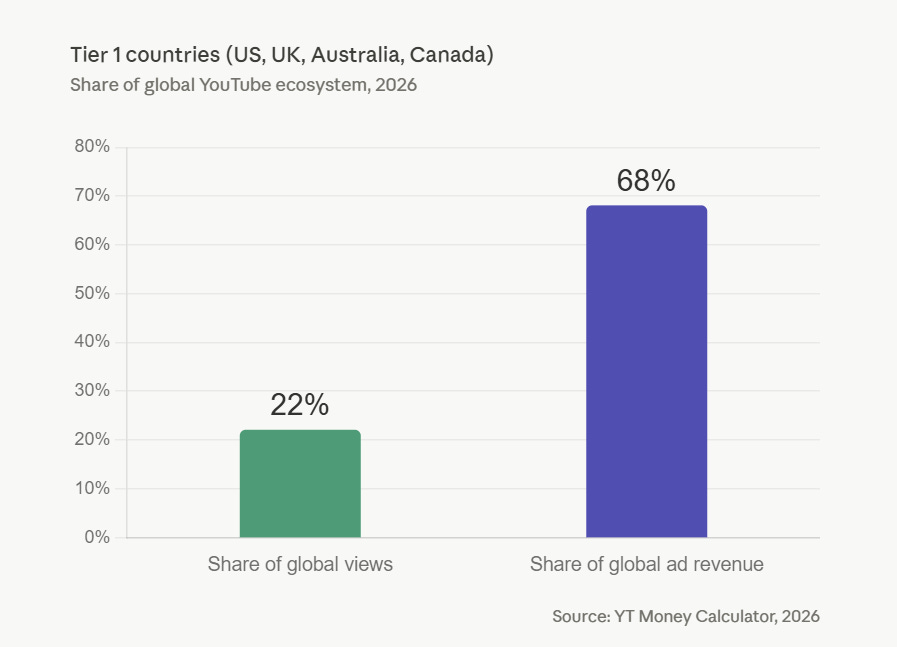
The ad revenue that flows from American eyeballs through Google’s platform to a rural Indian bank account is, in aggregate, one of the most frictionless income transfers ever created, and nobody designed it that way. It requires no government, no NGO, no application process, no means testing. It operates at the speed of attention and settles in the currency of wherever the creator happens to live. Tier 1 countries generate 68% of all YouTube ad revenue while representing only 22% of global views. The money concentrates where the purchasing power is. The content that captures that money comes from where it isn’t. That’s the pipeline. Nobody built it on purpose.
And here is the contradiction: if the system works, if the baker prospers, if the village develops, the aesthetic that attracted the attention erodes. The grandmother gets a modern kitchen. The baker’s village gets paved roads and better buildings. The stills between cooking shots stop looking like a window into another world and start looking like everywhere else. And the algorithm, which has no memory and no loyalty (I think about this a lot when I think about platforms as governance systems), moves on to the next untouched place, the next unoptimized life, the next texture that hasn’t been consumed yet.
I want to complicate my own argument here, because the evidence pushes back on me. Amar Kaur’s channel has been running since 2014. The Village Cooking Channel has been going since 2018. Both families have almost certainly transformed their financial situations by now. And the audiences haven’t left. Veg Village Food has 6.6 million subscribers and is still growing. The “algorithm moves on” prediction I’m making hasn’t materialized in either case. It’s possible that what draws viewers isn’t poverty as an aesthetic but cooking traditions and cultural texture that survive rising incomes, that the appeal is more durable than my thesis assumes. I’m less certain about the self-destruct timeline than I was when I started writing this. But I think the structural logic still holds: the system’s fuel source and its output are in tension, even if the tension plays out over decades rather than years.
So the system that alleviates poverty is fueled by poverty and undermined by its own success, probably on a longer timeline than I initially thought, and in ways that are harder to see than a simple before-and-after. That’s not a flaw in the design. That is the design.
What Happens When a Platform Becomes an Accidental Humanitarian System?
I’ve been trying to figure out what to call this thing, and none of the existing categories work.
It’s not aid, because aid is designed, targeted, and governed, and this is none of those things. It’s not charity, because the viewer on the couch doesn’t think of themselves as donating (they’re watching bread get made). And it’s not trade in any traditional sense, because no goods cross borders, no contracts exist between the parties, and the baker and the viewer will never negotiate, communicate, or know each other’s names. Everyone in the system is better off than they’d be without it, which is nice to say, but it doesn’t actually tell you what the system is. And it doesn’t account for the creators who can’t access the system at all, the ones in countries where the payment infrastructure simply won’t reach them, where the platform works right up until it’s time to get paid.
There’s a version of this observation, by the way, that an economist in the dependency theory tradition would rip apart. And they’d have a point.
The structure looks familiar if you squint: peripheral economies supplying raw material (in this case, “authenticity” and “cultural texture”) to core economies, with the terms of trade set entirely by the core.
YouTube keeps 45%. Google’s algorithm determines visibility. The creator has no bargaining power, no ownership of the distribution channel, and no recourse if the platform changes its mind.
You could draw a straight line from colonial resource extraction to this and argue the only thing that changed is the user interface. I don’t think that’s the full picture, because the directionality of value here is genuinely different from extraction (the creator retains the content, the audience, and the cultural knowledge), but I’d be dishonest if I pretended the pattern wasn’t visible. It’s visible. The question is whether “visible pattern” and “same thing” are the same thing. I don’t think they are, but I’m holding that loosely.
What it is, I think (and I’m still working this out, which is part of why I’m writing it), is something genuinely different. An accidental income transfer built on top of an advertising infrastructure that was designed, and I want to be precise here, every component of the system was engineered by one of the most sophisticated technology companies on earth.
YouTube’s algorithm, the AdSense auction, the recommendation engine that surfaced Amar Kaur’s samosa video to my couch in Arkansas, all of it was designed to maximize watch time. What wasn’t designed was the wealth transfer outcome. The system is intentional. The consequence is emergent. And the consequence is converting attention in one economic context into autonomy in another, at a speed and scale that nobody planned and nobody can replicate on purpose, because the moment you try to organize it, you introduce the optimization that destroys the authenticity that made it work in the first place.
Markets are coordination systems. They organize behavior, distribute access, shape timing, and determine who benefits from structure before anyone consciously chooses. What I watched on the couch that night was a coordination system doing something no policymaker, no development agency, no economist has managed to do with this little friction: moving real money from rich-country viewers to poor-country creators, with no bureaucracy, no overhead, and honestly no awareness on either side that the transfer is even happening.
We don’t have a language for a system that is simultaneously a media platform, an advertising exchange, an income-transfer engine, and a quiet engine of cultural extraction, all running without anyone at the controls. Maybe that’s the point. Maybe the reason it works is that nobody’s steering it.
What Should You Think About the Next Time You Watch a Village Cooking Video?
You’ve watched the video. You know the one. The baker in a dusty village. The grandmother stirring a pot big enough to feed a neighborhood. You watched it because it felt real, and it was.
But here’s the part that doesn’t show up on the screen: your view is worth the same to both creators. The algorithm doesn’t care where the creator lives. It prices your attention by where you sit, not where the content was made. And that same attention converts into a shrug for one creator and a lifeline for the other. Your view is worth the same to both of them. What it buys on the other side of the screen is not.
The baker pulls the bread from the oven. The camera holds. The village sits behind him, still and dry in the afternoon light. Somewhere else, Amar Kaur is feeding a hundred kids in a courtyard and 6.6 million subscribers are watching. Tori and I were two of them. Somewhere in the transaction between our attention and their food, money moved. Not much by our standards. Possibly a lot by theirs.
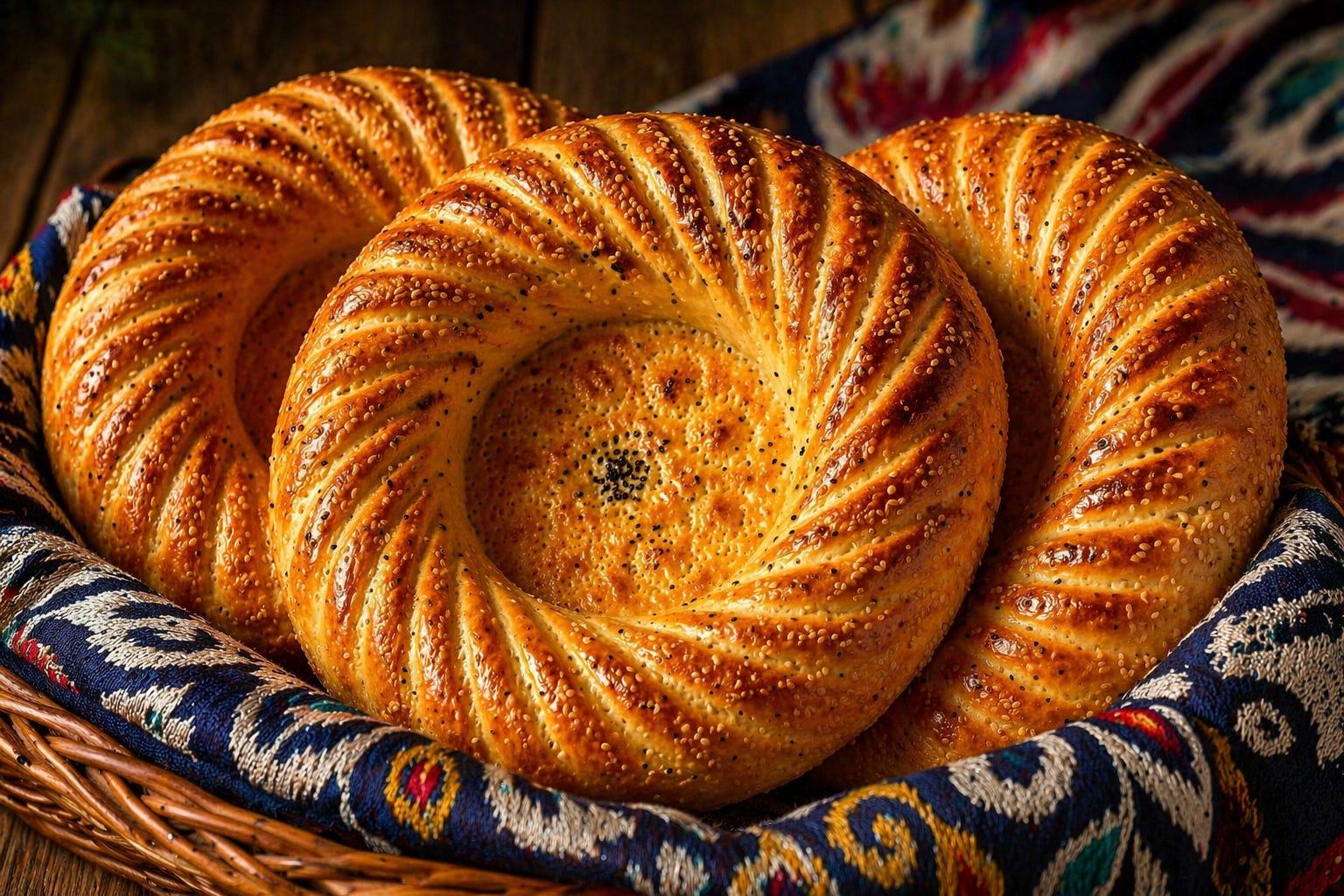
I don’t know the baker’s name. He doesn’t know mine. Google sits between us, keeping the books, taking its 45%.
The next time you watch one of these videos, and you will, because the algorithm is going to keep serving them to you, think about what’s actually happening underneath the thing you’re watching.
Your attention is currency. A view from your phone in Raleigh or Portland or Sydney is worth 30 to 45 times more than a view from the village where the content was made. That’s not a metaphor. That’s the exchange rate, and it’s running right now, every second, across every border, whether anyone understands it or not.
The most frictionless wealth transfer in modern history was built by accident, requires inequality to function, and will slowly erode the conditions that make it work.
The bread was quite beautiful, though.
FAQ
How does YouTube ad revenue actually flow to creators in developing countries?
YouTube places ads on videos and pays creators 55% of the resulting revenue. What a creator earns depends primarily on where their viewers are, not where the creator is. A video watched mostly by American audiences earns American-rate CPMs (roughly $33 per thousand views in 2026), even if the creator lives in a village where the average monthly income is $150. The payment flows through Google’s AdSense program into whatever bank account the creator has linked, converted to local currency. The creator keeps 55%. YouTube keeps 45%. No negotiation occurs.
Is the YouTube creator economy more effective than foreign aid?
Per unit of friction, for the creators it reaches, arguably yes. It requires no application, no bureaucracy, and no intermediary beyond the platform itself. But it’s tiny relative to global aid flows ($200 billion per year) and remittances ($650 billion per year), and it reaches individuals who happen to produce viral content rather than communities based on any measure of need. It’s a mechanism, not a policy. Comparing it to aid reveals more about the limitations of both than the superiority of either.
What happens to village creators when the YouTube algorithm changes?
That’s the fragility at the center of the whole thing. Platform dependence is already the central anxiety of Western creators, 70% of whom say an algorithm change could have serious effects on their life. For a creator whose entire village economy has reorganized around YouTube revenue, the stakes are existential in a way that’s hard to overstate. The system offers no safety net, no transition plan, and no appeals process. The same absence of bureaucracy that makes it efficient also makes it ruthless. And nobody in the system, not the creators, not the viewers, not the platform, has a plan for what happens when the most accessible path to economic mobility on earth runs through an algorithm someone else controls, and that algorithm decides to change.
Super interesting one! Great amount of detailed!
Interesting read. Kept me hooked through out. And I will check out Aman Kaur’s channel. My mum would love it too.
My read on all of this is just being a social media creator (Substack or YouTube or anywhere) else is too hard to sustain if you are starting right now. Math doesn’t work. Likes don’t pay the bills. It’s only the top 10% creators that make the big buck.