
Power Before Scale
What the Mongol Empire Reveals About Power, Markets, and the Limits of Scale

TLDR:
The Mongol Empire repeatedly defeated empires many times larger than itself by moving faster, coordinating more tightly, and letting reputation weaken resistance before battles were fought.
After conquest, the Mongols successfully ruled vast, complex civilizations unlike their own by stabilizing trade, protecting local institutions, and building systems of governance.
The same pattern appears in markets today: speed and alignment can overpower scale—until institutions form, coordination costs rise, and agility gives way to stability.
Power Before Scale
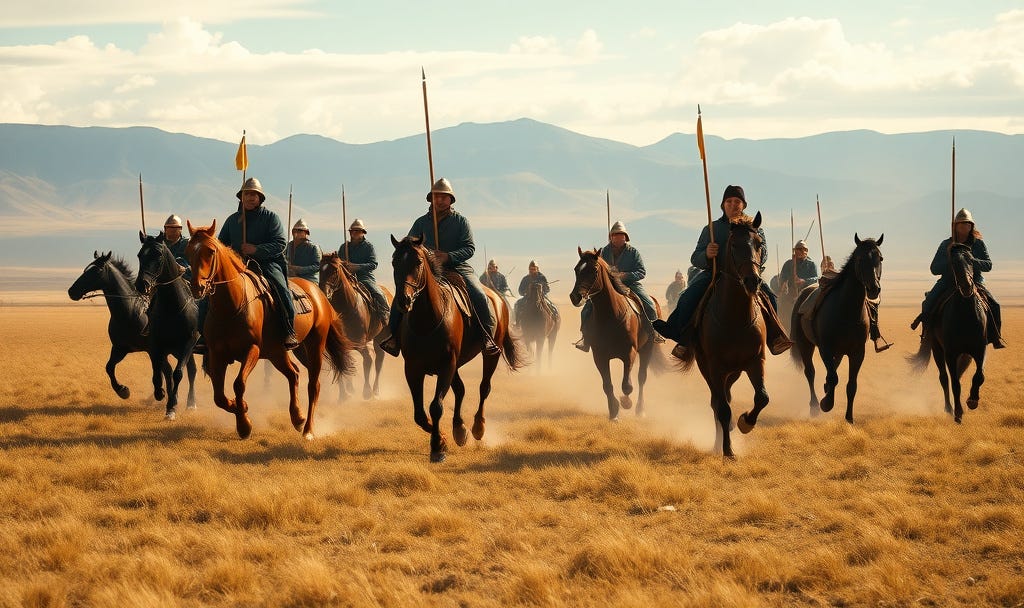
At its peak, the Mongol Empire ruled over more than 100 million people1 with an army that would barely fill a modern football stadium.
That fact alone should give us pause. It runs directly against how we usually think about power.
We tend to assume power comes from size—population, revenue, headcount, market share. Bigger feels safer. Bigger feels inevitable. Bigger feels powerful. And to be fair, sometimes it is.
But the Mongols showed that this intuition is not a law of nature.
They weren’t the most populous civilization. They weren’t the richest. They didn’t have the deepest institutions or the most sophisticated bureaucracy. And yet, for decades, they dismantled larger, wealthier, more “advanced” societies across Eurasia with startling consistency.
This wasn’t just about brutality or luck. Brutality was real, and luck always plays a role, but the Mongols had a genuine advantage in how their system worked.
They proved that scale does not automatically translate into power. Markets tend to forget this. Speed, coordination, and reputation can outweigh sheer size—at least until institutions adapt. That advantage can be decisive, but it is never permanent.
How the Mongols Overpowered Vast Empires Despite Their Size
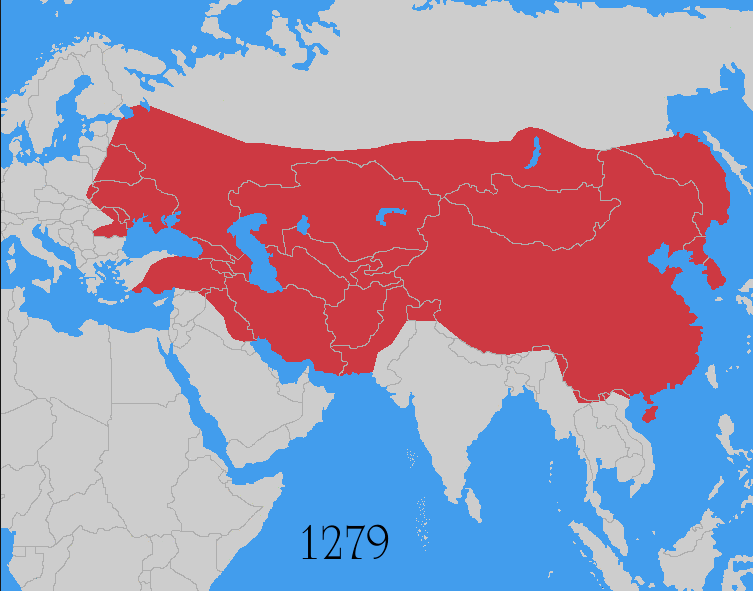
When the Mongols began their expansion in the early 13th century, they faced opponents that looked invincible on paper. Song China governed a population estimated at 90–120 million people, supported by one of the most advanced premodern economies in the world. It possessed large standing armies, fortified cities, gunpowder weapons, and a sophisticated bureaucratic state.
The Islamic world, stretching from Persia through Mesopotamia and into the eastern Mediterranean, was densely urbanized, commercially rich, and institutionally mature. Cities like Baghdad, Nishapur, Merv, and Samarkand were intellectual, economic, and administrative hubs with centuries of accumulated statecraft.
Europe, while more fragmented, was deeply entrenched in fortified feudal systems. Kingdoms and principalities relied on castles, armored knights, layered vassalage, and religious legitimacy. These societies were built to absorb shocks slowly and defend territory over long periods of time.
Given all this, the Mongols should not have been a major force.
The total Mongol population at the time of Genghis Khan’s unification in 1206 is generally estimated by historians to be well under one million, possibly closer to 700,000–900,000 people spread across the Eurasian steppe2. Their economy was pastoral and nomadic rather than agricultural or urban. They produced little surplus, had no cities, no written bureaucratic tradition, and no permanent administrative institutions in the conventional sense.
Their early military core was likewise small. Even generous estimates place the unified Mongol fighting force at well under 100,000 warriors at the outset of the empire.3 These were not mass armies drawn from dense populations, but mobile cavalry units drawn from a thin demographic base operating across vast distances.
By every conventional measure of power—population, wealth, industry, institutional depth—the Mongols should have been defeated quickly by the states they challenged.
Instead, they achieved the opposite.
Between roughly 1206 and 1260, Mongol forces defeated or annihilated dozens of major field armies across China, Central Asia, the Islamic world, and Eastern Europe. They shattered the Jin dynasty’s military structure in North China, dismantled the Khwarazmian Empire in a matter of years, destroyed coalition forces in Persia and the Caucasus, and routed European armies at battles like Legnica and Mohi.
These were not symbolic victories or lucky engagements. In many cases, the Mongols eliminated an opponent’s primary military capacity entirely, leaving states unable to defend themselves even if cities and fortifications still stood. Once a field army was destroyed, what remained was not a defender but an isolated system with no ability to coordinate a response.4
What the Mongols exposed—often in harsh ways—is that scale can create drag before it creates strength.
Large, mature systems accumulate layers: hierarchy, procedure, precedent, and internal negotiation. Mobilizing large armies requires coordination across political factions, supply chains, and command structures. Decisions move upward and outward before they move forward. By the time a response is organized, the strategic environment has already shifted.
The Mongols exploited this gap relentlessly. They moved faster than their opponents could gather forces, coordinate allies, or even understand what was happening. They forced engagements on their own terms, destroyed armies before they could combine, and advanced again before defensive systems could reset. Victory didn’t just defeat opponents—it removed their capacity to recover.
In markets, we see this pattern constantly. Incumbents don’t fail because they lack capital, talent, or infrastructure. They fail because they cannot move those resources fast enough. Their size, once an advantage, becomes a source of friction. Decision-making slows. Coordination costs rise. By the time action is approved, the opportunity has already passed.
The Mongols demonstrate a simple but uncomfortable principle: power depends less on size and more on speed, alignment, and timing. To understand why they were so effective, it helps to look at the thing they mastered better than anyone else—the ability to move faster than rivals thought possible.
How the Mongols Used Speed as a Weapon
The Mongols’ main advantage was not violence. It was speed.
They reduced the time between information, decision, and action to a level no rival society could match. In many cases, Mongol armies moved faster than their enemies’ messengers.5 Defenders often learned about an invasion only after it had already begun, or after their forward forces had been destroyed.
This was not accidental. It was structural.
Most premodern states relied on slow, fragile communication systems. Orders traveled by couriers along poorly maintained roads, often passing through multiple layers of authority. Decisions had to move up hierarchical chains and then back down again. Mobilization depended on feudal obligations, seasonal musters, or bureaucratic authorization. Even powerful states like Song China or the Abbasid Caliphate suffered from long delays between awareness and response.
The Mongols built a different system.
They invested heavily in what was effectively a continent-scale communications and logistics network known as the yam relay system. Relay stations were spaced roughly a day’s ride apart and stocked with fresh horses, food, lodging, and supplies.6 Official envoys carrying Mongol credentials could requisition resources and move continuously, allowing messages and intelligence to cross hundreds of miles in a matter of days.
This collapsed response time.
Orders from the center could reach the frontier faster than enemy states could convene councils. Scouting units ranged far ahead of main forces, gathering intelligence and reporting back with astonishing speed. Mongol commanders often had detailed knowledge of terrain, political divisions, and enemy movements before a campaign even began.
As a result, Mongol armies frequently arrived before defenders believed it was possible for them to arrive.
Campaigns unfolded before coalitions could form. Armies were engaged separately rather than collectively. Defensive plans were rendered obsolete mid-execution. By the time a state understood the scale or direction of the threat, the strategic situation had already changed.
This was not chaos. It was deliberate.
Mongol command philosophy emphasized intent over instruction. Senior leaders issued clear objectives rather than micromanaged orders. Subordinate commanders were expected to adapt locally while remaining aligned with the overall plan. Units were modular and standardized, able to detach, recombine, and maneuver independently without constant supervision.
Decisions were decentralized but aligned.
That alignment mattered. Many premodern armies decentralized authority by necessity, but without shared doctrine or trust. The Mongols decentralized deliberately, supported by training, discipline, and strict enforcement of loyalty. This allowed them to move quickly without fragmenting.
The result was a low-latency system operating inside high-latency competitors.
Speed also produced a powerful psychological effect. News of Mongol destruction often traveled ahead of the armies themselves.7 Refugees fled cities before Mongol forces arrived. Rumors of annihilated armies and erased cities spread across trade routes and diplomatic networks. By the time Mongol columns approached new regions, resistance had already been shaped by fear, uncertainty, and incomplete information.
Europe provides a stark example. In the 1240s, reports of Mongol victories in Eastern Europe spread faster than accurate intelligence. European chroniclers described them as unstoppable, even apocalyptic forces.8 European rulers prepared defenses and issued prayers before fully understanding who the Mongols were or what they wanted.
Fear preceded contact.
This created a powerful feedback loop. Early victories amplified reputation. Reputation accelerated submission. Submission reduced resistance. Reduced resistance increased speed. Speed generated more victories. The loop reinforced itself.
In modern terms, the Mongols weren’t just moving faster. They were operating inside a system where perception, information, and action compounded together.
Their advantage was not overwhelming force, but faster decision and response cycles than anyone they faced. They shortened the distance between signal and action while their competitors were still processing the signal. By the time incumbents reacted, the outcome had already been decided.
How the Mongols Achieved Coordination Through Loyalty and Control
Speed alone isn’t enough. It only matters if everyone is moving in the same direction.
The Mongols solved this problem through ruthless organizational simplicity, supported by an unusually sophisticated system of loyalty, incentives, and constraints. Their military organization was standardized, modular, and interchangeable. Units followed a decimal structure, commanders knew exactly what they were responsible for, and expectations were clear long before a campaign began.
Roles were not inherited; they were earned. Promotion was based on performance and loyalty rather than noble lineage. A former enemy who proved capable could rise. A noble who failed could fall. This dismantled the tribal factionalism that had defined steppe politics for generations and replaced it with personal loyalty to the center.
Loyalty flowed upward. Autonomy flowed downward.
Mongol commanders were given wide latitude to execute objectives as they saw fit, but betrayal was treated as an existential threat to the system. Defection, conspiracy, or opportunistic disobedience were punished swiftly and publicly. Consequences were clear, and ambiguity was minimal. Coordination became safer than scheming, and alignment became rational self-interest.
The result was not blind obedience, but predictable behavior under pressure.
They didn’t need massive armies because they didn’t waste effort fighting themselves. Internal conflict was resolved early, brutally if necessary, so it didn’t metastasize during campaigns. Once a force was in the field, it functioned as a coherent whole rather than a temporary coalition.
Opponents, by contrast, often collapsed not from defeat, but from internal fracture once coordination broke down.
European armies were frequently loose confederations of nobles whose loyalty was conditional and time-bound. Islamic and Chinese forces, while more centralized, were constrained by layered bureaucracies, court politics, and competing institutional priorities. Mobilization required negotiation. Command required consensus. Execution required patience.
Those armies were large, but they were not aligned.
The Mongols extended this coordination logic beyond the battlefield. They did not attempt to homogenize the cultures they conquered.9 Local institutions were often left intact. Religious practices were protected rather than suppressed. Administrators, merchants, priests, and scholars were allowed to continue their work as long as they acknowledged Mongol authority and paid tribute.
This was not tolerance out of idealism. It was coordination at a civilizational scale.
By leaving local systems in place, the Mongols avoided the coordination costs of forced assimilation. They ruled lightly from the top, intervening primarily to extract resources, maintain order, and enforce loyalty. The day-to-day functioning of society remained familiar, reducing friction and resistance.
In effect, the Mongols centralized power while decentralizing operations.
In markets, coordination is an invisible asset. It doesn’t show up on balance sheets, but it determines whether scale amplifies power or magnifies inefficiency. Organizations that grow without alignment accumulate internal drag. Organizations that enforce alignment early can remain small while exerting outsized influence.
The Mongols understood this intuitively. Volume mattered far less than coherence. A smaller, unified force consistently outperformed larger systems burdened by internal contradiction.
How the Mongols Turned Conquest into Trade Power
What often gets missed is why the Mongols were willing to accept this tradeoff.
They were not trying to conquer endlessly for conquest’s sake. They were trying to unlock and control flows of goods, people, information, and tribute across Eurasia.
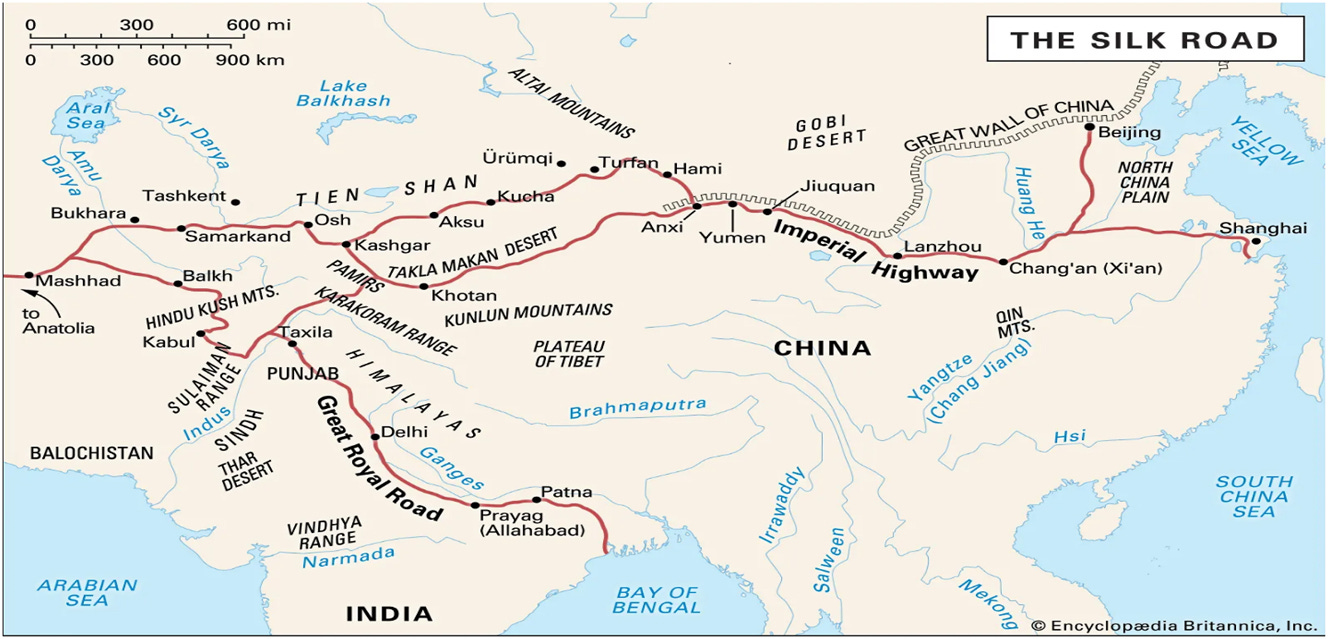
Once large-scale resistance was crushed, the Mongols deliberately pivoted toward stabilizing trade. Under what later historians would call the Pax Mongolica, long-distance commerce became safer and more predictable than it had been for centuries.10 Caravan routes were protected. Banditry was punished. Merchants were granted legal protections, tax privileges, and access to Mongol relay infrastructure.
This mattered enormously.
Silk, spices, silver, textiles, technologies, and ideas moved with unprecedented speed and reliability from East Asia to the Mediterranean. Merchants accumulated wealth. Cities along trade corridors flourished. Tribute and taxation increasingly replaced plunder as the empire’s economic foundation.
The Mongols understood something subtle: violence opens markets, but trade sustains them.
Their religious tolerance and willingness to leave local institutions intact were not acts of benevolence. They were economic strategy. By allowing different faiths and administrative systems to operate freely, the Mongols reduced friction in exchange networks. Stability encouraged commerce. Commerce generated revenue. Revenue reduced the need for constant conquest.
In market terms, the Mongols transitioned from disruptors to platform operators.
But platforms require rules, enforcement, and predictability. And that meant institutions.
How the Mongol Empire Shifted from Conquest to Governance
If the story ended with conquest, the lesson would be dangerously incomplete.
The Mongols’ advantage didn’t last forever.
Under Genghis Khan, the empire was optimized almost entirely for movement, punishment, and coordination. Genghis ruled less as a bureaucrat than as a system architect. He unified the steppe through personal loyalty, enforced discipline with brutal clarity, and focused relentlessly on speed and alignment. Governance, where it existed, was minimal and instrumental.
That model worked astonishingly well for conquest.
But as the empire expanded across sedentary civilizations, its center of gravity began to shift. Genghis’s sons and grandsons inherited not just armies, but millions of people who needed to be fed, taxed, governed, and kept from rebelling. Cavalry could shatter armies, but it could not collect grain, administer justice, or manage complex agrarian societies.
Nowhere was this tension clearer than in China.
When Kublai Khan completed the conquest of the Southern Song and declared the Yuan dynasty, he made a decisive choice. He would rule China as China, not merely extract tribute from it. That meant adopting census systems, taxation, law codes, court ritual, and permanent administration. Beijing became a fixed capital. Paper currency expanded. Chinese bureaucrats were incorporated into governance.11
This shift was necessary—and fatal to the original advantage.
Institutions slow systems down, but they also stabilize them. They replace improvisation with procedure and trade agility for durability. Kublai understood that endless conquest was no longer the goal. Maintaining legitimacy and revenue from the richest agrarian economy in the world now mattered more than speed.
The Mongol system pivoted from movement to management.
Marco Polo’s accounts make this transition visible. What he described was not a barbarian horde, but a highly organized imperial system with efficient postal routes, standardized taxation, religious tolerance, bustling trade cities, and administrative reach beyond anything Europe had seen. His descriptions of paper money, coal usage, massive urban centers, and state capacity reshaped European imaginations.12
But what Polo witnessed was already a different Mongol Empire.
The qualities that had made the Mongols unbeatable—rapid decision-making, minimal hierarchy, extreme flexibility—were being replaced by bureaucracy, ritual, and institutional inertia. The empire became harder to disrupt, but also harder to steer.
In markets, this transition is familiar. Founder-led speed gives way to compliance, process, and predictability. The system becomes more stable, but less responsive. The qualities that enable breakout growth rarely survive intact once scale demands formal governance.
Why the Mongol Empire Fragmented After Reaching Its Peak
The final break came when top-level coordination failed.
After the era of extraordinary leaders—Genghis, Ögedei, Möngke, and Kublai—the empire faced a problem it could not solve with speed or discipline alone: succession. There was no fully institutionalized mechanism capable of reliably transferring authority across generations without conflict.
The result was fragmentation.
The Mongol Empire split into regional powers: the Yuan in China, the Ilkhanate in Persia, the Chagatai Khanate in Central Asia, and the Golden Horde in the west. Each was viable on its own. None could reconstitute the whole. The system had scaled beyond the capacity of personal trust and shared intent.
This is the hidden cost of scale. Coordination overhead grows faster than power unless institutions compensate for it. And institutions, once built, tend to ossify.
In China, this ossification proved fatal. The Yuan dynasty struggled with legitimacy. Mongol elites remained culturally distinct from the majority Han population. Court politics hardened. Fiscal strain increased. Natural disasters and economic disruption weakened confidence in the regime.
By the mid-14th century, rebellion followed.
The Ming dynasty overthrew the Yuan not through superior speed, but through institutional depth, cultural legitimacy, and mass mobilization. Where the Mongols had once destroyed response capacity, the Ming rebuilt it. Where Mongol rule relied on elite coordination, Ming rule rested on deeply rooted administrative norms and popular support.13
The irony is instructive.
The Mongols conquered the world by outpacing institutions.
They lost it by becoming one.
The informal mechanisms that worked when the organization was small—personal loyalty, shared culture, direct oversight—could no longer carry the load. Formal institutions were required, but those institutions diluted the speed and coherence that had made the system dominant in the first place.
When leadership becomes average instead of exceptional, systems built for velocity fracture under their own weight.
The Real Lesson of the Mongol Empire for Modern Markets
The Mongols didn’t win because they were uniquely violent or culturally superior. They won because they moved faster than the systems designed to stop them.
They collapsed response loops before institutions could react. They aligned people faster than hierarchies could coordinate. They let reputation and fear do the work before force ever arrived.
But they lost their edge the moment the world they conquered demanded something different.
Once markets stabilized, trade expanded, and millions of people depended on predictable outcomes, speed alone was no longer enough. Power shifted from movement to maintenance, from improvisation to legitimacy, from conquest to governance.
This is not a failure mode. It is a transition.
Markets follow the same arc.
Speed beats size.
Coordination beats resources.
Reputation shapes resistance.
Trade rewards stability.
But stability demands rules. Rules demand institutions. And institutions, once established, slow the very systems that created them.
This is the paradox every dominant platform, marketplace, or ecosystem eventually faces. The qualities that allow you to outpace incumbents are not the same qualities that allow you to govern what you’ve built.
Move too slowly, and you never break through.
Move too fast for too long, and the system outruns its own legitimacy.
The lesson of the Mongols isn’t how to conquer markets.
It’s knowing when conquest stops working, and recognizing the moment power shifts from expansion to stewardship.
Every system that grows large enough eventually confronts the same choice the Mongols did:
Do you want to keep moving fast?
Or do you want to last?
FAQ
Why were the Mongols able to defeat much larger empires?
Because they moved faster than their opponents could react. The Mongols reduced the time between information, decision, and action, destroyed enemy field armies before coordination was possible, and used reputation to weaken resistance before battles even began.
What does the Mongol Empire have to do with modern markets?
The same dynamics apply. Startups and challengers often win not because they’re bigger, but because they’re faster, more aligned, and less burdened by institutional friction. Over time, as organizations scale, those same institutions that provide stability also slow innovation.
Why did the Mongol Empire eventually decline?
As the empire shifted from conquest to governance, speed gave way to bureaucracy. Succession conflicts, institutional rigidity, and legitimacy challenges fragmented authority. The Mongols didn’t fail because they were weak—they declined because the system they built required stability over speed.
Sources & References
Morgan, D. (2007). The Mongols (2nd ed.). Blackwell Publishing.
https://www.wiley.com/en-us/The+Mongols%2C+2nd+Edition-p-9780631214083
Atwood, C. P. (2004). Encyclopedia of Mongolia and the Mongol Empire. Facts On File.
https://www.encyclopedia.com/history/encyclopedias-almanacs-transcripts-and-maps/encyclopedia-mongolia-and-mongol-empire
May, T. (2007). Mongol Warfare. Da Capo Press. https://www.perseusbooks.com/titles/timothy-may/mongol-warfare/9780306811867/
Allsen, T. T. (1989). Mongol imperialism: The policies of the Grand Qan Möngke. University of California Press. https://publishing.cdlib.org/ucpressebooks/view?docId=ft4h4nb2b6
de Rachewiltz, I. (2004). The Secret History of the Mongols. Brill. https://brill.com/display/title/8449
Weatherford, J. (2004). Genghis Khan and the Making of the Modern World. Crown Publishing. https://www.penguinrandomhouse.com/books/97119/genghis-khan-and-the-making-of-the-modern-world-by-jack-weatherford/
Jackson, P. (1999). The fear of the Mongols in medieval Europe. Journal of Medieval History, 25(3), 241–265. https://www.tandfonline.com/doi/abs/10.1016/S0304-4181(99)00011-6
Vercamer, G. (2021). Mongol invasions and the apocalyptic imagination in medieval Europe. Speculum, 96(2), 389–421. https://www.journals.uchicago.edu/doi/10.1086/713131
Atwood, C. P. (2019). The Mongol Empire and Its Legacy. Brill. https://brill.com/display/title/39130
Abu-Lughod, J. L. (1989). Before European Hegemony: The World System A.D. 1250–1350. Oxford University Press. https://global.oup.com/academic/product/before-european-hegemony-9780195067743
Rossabi, M. (1988). Khubilai Khan: His Life and Times. University of California Press.
https://publishing.cdlib.org/ucpressebooks/view?docId=ft8t1nb5ht
Polo, M. (1298/2008). The Travels of Marco Polo (R. Latham, Trans.). Penguin Classics. https://www.penguinrandomhouse.com/books/26142/the-travels-of-marco-polo-by-marco-polo/
Dreyer, E. L. (1982). Early Ming China: A Political History, 1355–1435. Stanford University Press. https://www.sup.org/books/title/?id=2380
Absolutely killer synthesis. The point about the Mongols operating inside their opponents' decision loops is essentially a premodern OODA loop advantage, which makes the business parallels even more direct. What's wild is how many modern companies repeat the Yuan dynasty mistake of optimzation locking them into a specific structure right when conditions shift. Saw a fintech go through exactly this after thier Series B growth phase.
excellent article worth the read